


Consolidate Glean + Kapa: One AI Platform for Internal and External Search (2026)


Should you consolidate Glean and Kapa into one platform? Decision framework and evaluation scorecard for enterprise AI search consolidation.
Consolidate when internal and external AI share overlapping content.
Decision
Should you consolidate Glean and Kapa into one platform?
Yes—consolidate when you need both internal enterprise search AND public-facing AI assistants. Keep separate tools only if use cases are truly isolated (rare in technical companies).
The consolidation ROI compounds: single content pipeline, unified analytics, one vendor relationship.
Companies running unified enterprise search and RAG report the same architecture handles both internal and customer-facing queries—no duplicate pipelines, no content drift between answers.
In conversations with enterprise ops leaders, the pain point surfaces quickly: teams running separate stacks maintain two content sources while paying twice.
Decision Framework
79% of CIOs rank AI/ML as their top innovation priority. Yet most still run fragmented stacks that undermine that priority.
Before evaluating platforms, lock in these four non-negotiables:
| Criterion | What to Look For | Why It Matters |
|---|---|---|
| Product Expert Chat | Embeddable widget serving answers from both internal and external docs with full configurability | One interface for employees and customers eliminates duplicate content pipelines |
| Enterprise Search | Semantic search that parses intent, not just keywords | Keyword matching misses 60%+ of relevant results on technical queries |
| Inline Citations | Every response links directly to source documents—clickable, verifiable | Support agents won't trust AI without proof. Neither will customers. |
| Guardrails | Content filtering, confidence scoring, automatic escalation when AI is uncertain | Uncontrolled AI generates support tickets, not deflections |
Enterprise teams consistently report needing to improve documentation for highly technical developer questions. Generic AI fails here. Purpose-built guardrails catch uncertainty before it reaches users.
CIOs are narrowing platform stacks to reduce complexity, improve governance, and accelerate AI deployment at scale.
What Breaks at Enterprise Scale
95% of companies see little to no measurable ROI from AI initiatives. The culprit is a fragmented knowledge architecture.
Here's what actually fails when you run separate internal and external AI tools:
-
Duplicate Content Pipelines — Syncing documentation to two platforms means double the maintenance burden. Teams report content drift within 90 days—internal answers diverge from customer-facing docs, creating contradictory responses across channels.
-
Fragmented Analytics — Customer questions and internal queries live in separate systems. You can't identify documentation gaps holistically when insights are siloed. A support trend visible in external AI won't surface in internal search analytics.
-
Pricing Lock-In — All-or-nothing pricing forces teams to over-buy or under-serve specific use cases. When platforms lack incremental adoption paths, consolidation stalls at pilot stage.
-
Technical Configuration Gaps — Generic AI struggles with highly technical developer questions. This gap compounds when tools aren't purpose-built for technical audiences.
When AI is anchored in unified, searchable knowledge, ROI materializes. When AI is layered on top of fragmented data, the value stalls.
Evaluation Scorecard
Skip feature comparison theater. Focus on what to test in your environment.
Most vendor scorecards compare checkboxes. That's useless when both platforms check the same boxes differently. Evaluate against criteria that predict consolidation success.
| Capability | What to Test | Single-Platform Advantage |
|---|---|---|
| Product Expert Chat | Index internal AND external docs in one pass. Ask the same question both ways—answers should match. | One content pipeline eliminates drift |
| Enterprise Search | Run 50 real queries from last month's support tickets. Measure semantic accuracy, not keyword hits. | Unified semantic search replaces Algolia-style matching |
| Inline Citations | Click every source link. Verify it lands on the exact paragraph, not just the page. | Every response includes clickable inline citations |
| Guardrails | Test edge cases: ambiguous questions, outdated content, questions outside your domain. | Built-in confidence scoring with automatic escalation |
The cost math compounds quickly. Organizations report 70% search cost reduction when consolidating to unified platforms versus maintaining proprietary stacks. One enterprise documented $175,000+ in annual savings from search consolidation alone.
Teams running separate internal and external AI tools report content drift within 90 days. Internal answers diverge from customer-facing docs because two pipelines mean two maintenance schedules.
How Inkeep Helps
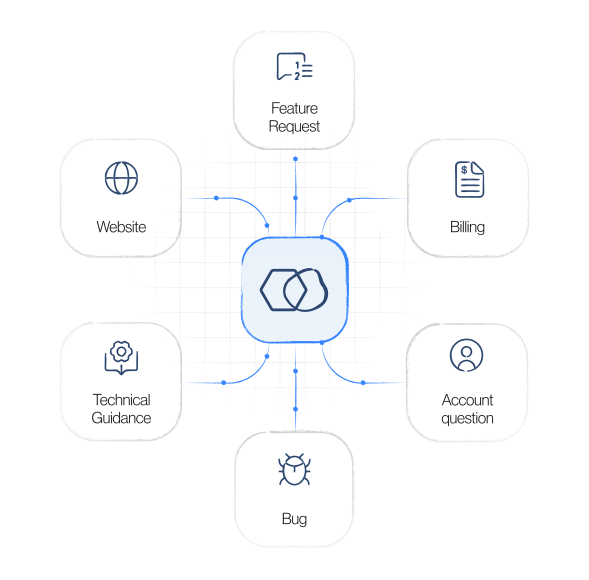
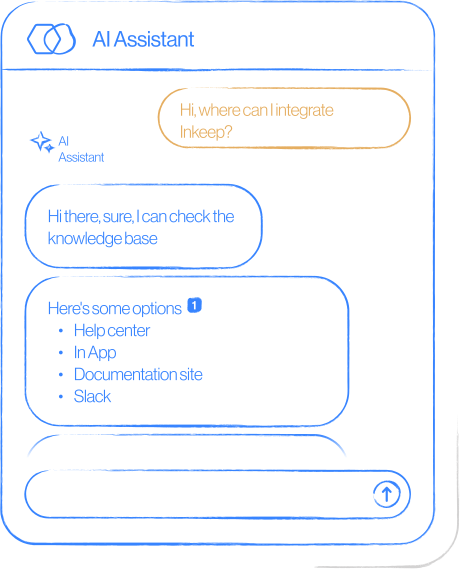
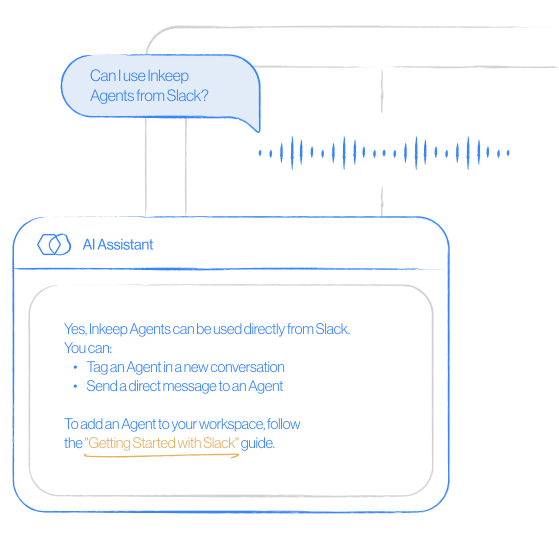
Inkeep runs one RAG engine for both internal and external search. Index your docs once, serve consistent answers everywhere.
-
Single content pipeline eliminates drift between what customers see and what support agents reference (INK-005)
-
Inline citations let customers verify sources in one click and agents trust answers without cross-checking (INK-004)
-
Semantic search replaces keyword matching with intent-based retrieval (INK-009)
-
Confidence-based escalation triggers human handoff when AI is uncertain (INK-011)
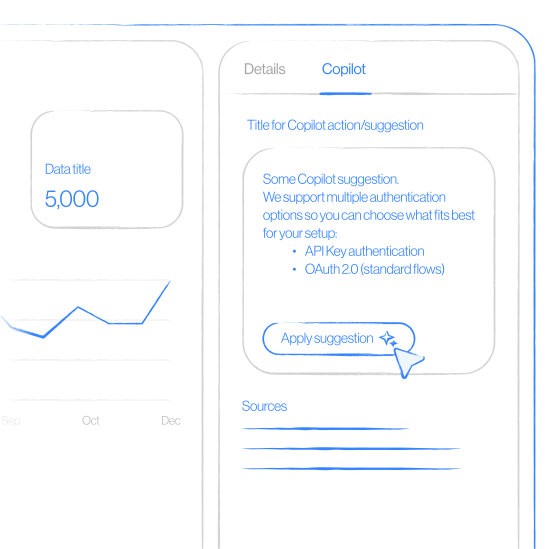
Gap analysis surfaces where documentation fails—across customer questions and internal queries in one view. Organizations using unified enterprise AI search report 70% reduction in knowledge retrieval time.
Recommendations
Your role determines where consolidation delivers fastest value.
For DevEx Leads: Start with public docs AI, then expand inward. Validate your content pipeline on customer-facing search first—external users surface gaps faster than internal teams. Once indexing quality meets your standard, extend the same architecture to internal search. Inkeep's TypeScript SDK lets developers customize while business users configure through the visual builder.
For Support Directors: Prioritize citation accuracy and escalation guardrails above all else. Ticket deflection initiatives live or die on trust. Agents won't use AI that can't prove its sources. Confidence-based escalation matters equally—when AI uncertainty triggers automatic handoff, support quality stays consistent.
If you're paying for both tools: Don't migrate everything at once. Run a 30-day pilot on one content domain. Pick documentation that serves both internal teams and customers. Measure three things: citation accuracy, answer consistency between audiences, and content maintenance hours saved.
The consolidation case is strongest for technical companies where internal and external knowledge overlaps. If your use cases truly never intersect, separate tools may still make sense. That's rare.
Next Steps
The consolidation decision is binary: either you're paying for duplicate content pipelines, or you're not.
See It in Your Environment
Generic demos prove capability. Your data proves fit.
Request a demo to test consolidated internal + external AI against your actual documentation. Bring your hardest technical questions—the ones that break generic RAG systems.
What to evaluate in the demo:
-
Citation accuracy on your domain-specific content
-
Escalation behavior when confidence is low
-
Gap analysis output from real customer questions
Assess Any Platform
Not ready for a demo? Start with structured evaluation.
Use an enterprise evaluation rubric to score any platform against the four criteria: product expert chat, enterprise search, inline citations, and guardrails.
If You're Currently Running Separate Tools
Request pilot on one content domain. Measure content drift between platforms before and after. The delta quantifies your consolidation ROI.
Frequently Asked Questions
When documentation serves both employees and customers.
Two content pipelines mean two maintenance schedules.
Run 50 real support queries and measure semantic accuracy.
Organizations report 70% reduction in search costs.