


The $304/Hour Tax: When Product Teams Become Support Bottlenecks
Product engineers cost $304/hour when pulled into support. Learn when AI automation delivers ROI—and why gap reporting beats deflection metrics.

SUMMARY
Engineers cost $304/hour in opportunity cost when answering support questions.
Deflection metrics hide problems—gap reports reveal what's actually broken.
5+ hours weekly on internal questions signals immediate automation ROI.
Wrong AI just shifts dependency from one person to another.
Surface knowledge gaps, don't just automate answers.
Decision
Should you automate support to reduce product team interruptions?
Yes, but only if the solution surfaces knowledge gaps, not just deflects tickets.
Engineers cost $304/hour in opportunity cost when pulled from projects. That's not just incident time. It's every Slack ping asking "where's the doc for X?" or "who knows how this policy works?"
Here's the real problem: tribal knowledge creates single points of failure.
One engineer holds context that blocks deals and stalls development. Incident management tools don't fix this—they track what went wrong, not what's missing.
So here's the threshold: if product engineers spend more than 5 hours weekly answering internal questions, automation ROI is immediate. That's $79,040/year per engineer in recaptured capacity.
74% of executives achieve AI agent ROI within the first year. But the wrong solution just shifts the bottleneck. Here's how to evaluate whether a solution actually solves it.
Decision Framework
Most AI support tools optimize for the wrong metric: ticket deflection. High deflection rates look good in dashboards but hide a critical failure, you never learn why customers struggled in the first place.
Evaluate solutions on whether they surface gaps, not just answer questions.
| Criterion | What to Look For | Why It Matters |
|---|---|---|
| Knowledge Gap Reports | Identifies unanswered questions, missing docs, and contradictory information—not just answer volume | Reveals what's broken in your documentation before it creates more tickets |
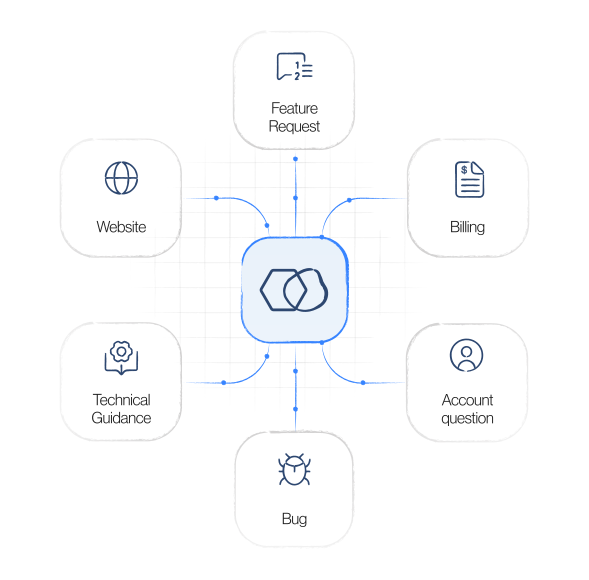
| Feature Gap Reports | Surfaces what users request that doesn't exist, categorized by frequency and urgency | Turns support conversations into product roadmap intelligence |
| Actionable Recommendations | Specific next steps ("Add X to FAQ," "Clarify Y policy") vs. generic dashboards | Teams act immediately instead of interpreting charts |
A tool that answers 90% of questions but never flags the 10% causing confusion just shifts the bottleneck. You need visibility into the gaps—unanswered questions that expose missing documentation, conflicting policies, or feature requests hiding in support threads.
Even solutions that check these boxes can fail at scale.
Trade-offs
AI support tools promise efficiency. Without proper implementation, they create new problems while hiding old ones.
Deflection without insight. Ticket counts drop, dashboards turn green, and leadership celebrates. Meanwhile, no one learns why customers struggled. The 31% IT cost reduction from intelligent automation only materializes when you capture learning, not just deflect volume.
Dependency shifts, not disappears. Tribal knowledge moves from "the product expert" to "the person who maintains the AI." You've replaced one single point of failure with another. When that person leaves, you're back to square one—but now with a black box.
Hidden policies cause development clashes. Your AI answers questions confidently. But it doesn't flag when two internal documents contradict each other. The AI knows the answers exist. It doesn't know they conflict.
Sales loses confidence. When technical questions require escalation, deal cycles slow. Knowledge bottlenecks create 13,892 person-hours lost annually per 1,500 engineers—and that's just the engineering side.
The common thread: these tools answer questions but don't surface gaps.
How Inkeep Helps
Inkeep addresses the root cause: surfacing what's missing, not just answering what's asked.
-
Gap analysis reports identify unanswered questions and missing documentation from real customer conversations—so you learn which tribal knowledge never made it into your docs.
-
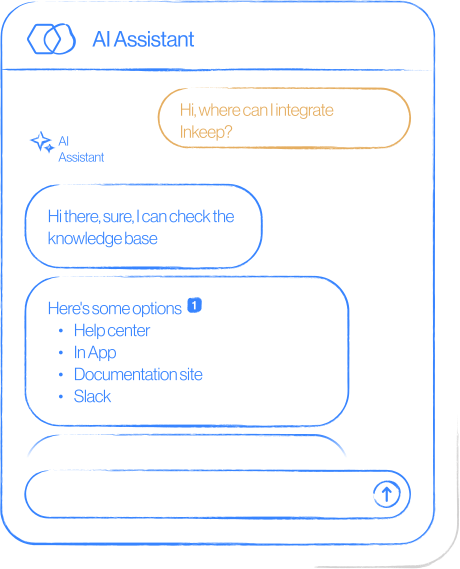
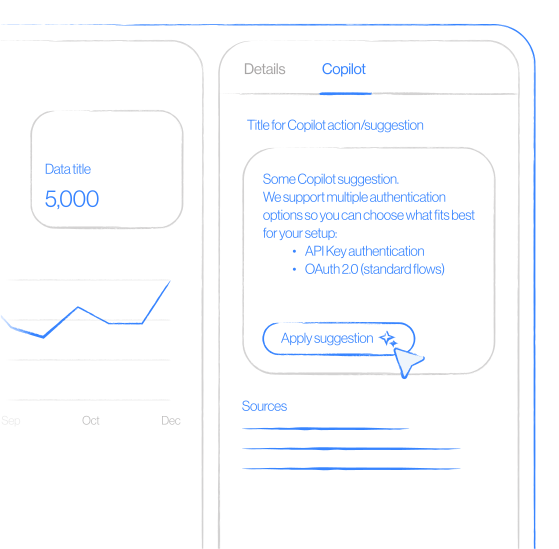
Source citations on every answer let support agents verify accuracy in one click rather than escalating to product engineers
-
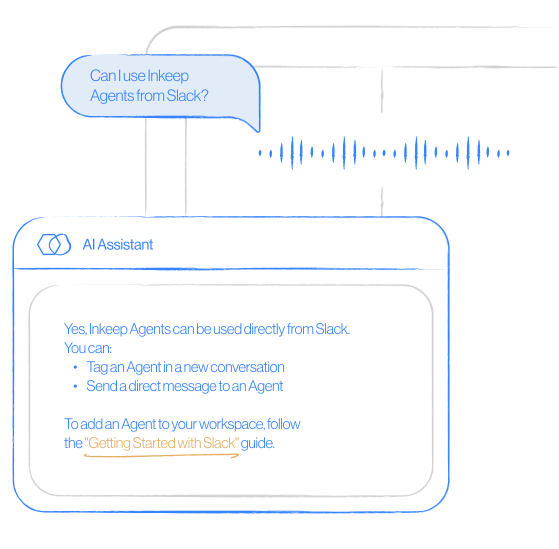
Unified deployment across Zendesk co-pilot, customer-facing chat, and enterprise search—no new silos, no shifting dependency to "the person who maintains the AI"
Companies like Anthropic and PostHog use Inkeep to reduce escalations and speed onboarding. The difference: they're not just answering tickets faster—they're systematically closing the knowledge gaps that created those tickets.
Recommendations
Your next step depends on where bottlenecks hit hardest.
For DevEx leads: Audit how many hours weekly product engineers spend answering internal support questions. If it exceeds 5 hours, multiply by $304 to see your weekly opportunity cost. A senior engineer fielding 8 hours of questions weekly costs $126,000 annually in lost development capacity.
For Support Directors: Evaluate whether your current tools report on knowledge gaps—not just deflection rates. Deflection metrics tell you tickets decreased. Gap reports tell you why customers struggled and what documentation is missing. The latter prevents future tickets; the former just hides them.
If you need quick wins: Start with customer-facing chat before tackling internal knowledge silos. Reducing inbound volume shows measurable ROI faster and builds organizational buy-in for broader rollout.
The pattern across all three: measure gaps, not just volume.
Next Steps
The hourly engineering cost compounds every week you don't address it. The question: does your current tooling surface what's missing—or just deflect what's visible?
-
Request a Demo — See gap analysis running on your own documentation
-
Download the Evaluation Rubric — Use our framework to assess any AI support platform
Quick self-assessment: Track how many hours your product engineers spend answering internal questions this week. Over 5 hours means $1,500+ in opportunity cost weekly—before counting development delays and slower deals.
Start measuring the hidden tax.
Frequently Asked Questions
When product engineers spend 5+ hours weekly answering internal questions.
They hide why customers struggled—you never fix the root cause.
Knowledge gaps and feature requests, not just ticket volume.
Choose tools that surface missing documentation, not just answer questions.