


Why Speed Alone Won't Fix Your Search Experience


Fast search isn't enough. Learn why understanding user intent matters more than millisecond response times for technical documentation and support.
Latency matters, but relevance matters more—a 50ms wrong answer is worse than a 200ms correct one
Search infrastructure conversations often center on performance metrics: response times, query throughput, scalability limits. These matter—nobody wants a slow search experience. But after working with technical companies on their documentation and support search, we've noticed something: speed is table stakes, not the solution.
Why This Matters
The traditional approach to search optimization focuses on guardrails and limitations designed to maintain fast, scalable performance. Index size limits. Query complexity caps. Record attribute constraints. These engineering decisions make sense when your goal is returning keyword matches in milliseconds.
But here's what we've learned from conversations with DevEx leads and support teams: users don't care about your search latency if they can't find what they need.
A developer searching for "single login" doesn't want a fast "no results found" message. They want your search to understand they might mean "single sign-on" or "SSO authentication." The milliseconds you saved mean nothing if they have to reformulate their query three times.
What We've Observed
In sales conversations, teams evaluating search solutions consistently surface the same frustration: keyword matching doesn't handle how their users actually search.
One prospect described the gap between their current search and what they needed: semantic understanding that handles synonyms naturally—recognizing that "single login" and "sign on" describe the same concept. Traditional search architectures, optimized for speed through exact matching, struggle here by design.
We've also heard teams prioritize something that rarely appears in search performance benchmarks: what happens when the answer doesn't exist. When documentation has gaps, the worst outcome isn't a slow response—it's a confident-sounding wrong answer. Teams tell us they'd rather have a vague "I'm not sure" than a fast hallucination that sends developers down the wrong path for hours.
Our Perspective: Intent Over Speed
The search paradigm is shifting from "find documents containing these words" to "understand what this person needs and help them get there."
This requires rethinking what search infrastructure should optimize for:
1. Semantic understanding, not just tokenization
Modern search should grasp that a query about "deployment errors" relates to content about "CI/CD failures" and "build pipeline issues"—even if those exact words don't appear in the query. This isn't about fuzzy matching or synonym dictionaries you manually maintain. It's about search that understands your domain.
2. Conversational context, not isolated queries
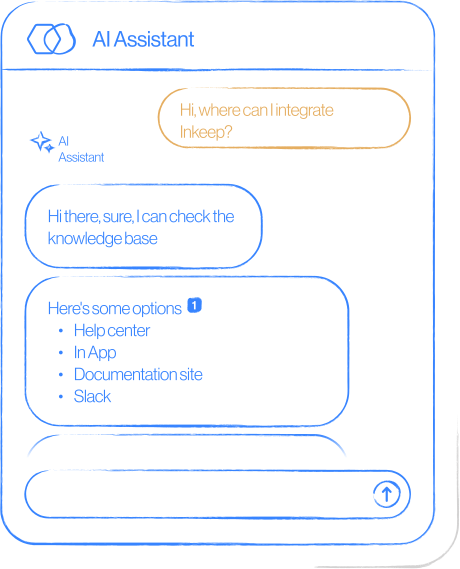
When someone searches your docs, they're often partway through solving a problem. They have context from previous pages, error messages they're seeing, a specific integration they're working with. Search that treats each query as independent misses opportunities to help.
3. Citations and traceability
Speed becomes a liability if it comes at the cost of trustworthiness. Technical users need to verify answers—they're not going to copy-paste a code snippet into production without checking the source. Every answer should trace back to your actual documentation, not an AI's best guess.
4. Visibility into gaps
The searches that return nothing are often more valuable than the searches that succeed. They tell you exactly where your documentation is failing your users. If you're optimizing purely for throughput, you're missing this signal.
What Teams Are Actually Evaluating
Based on our conversations, here's what technical companies prioritize when choosing search infrastructure:
-
Can it handle how our users actually phrase questions? Not just exact keyword matches, but conceptual understanding.
-
What happens when it doesn't know? Teams want honest uncertainty over confident errors.
-
Can we see where our content falls short? Gap analysis based on real queries reveals documentation priorities.
-
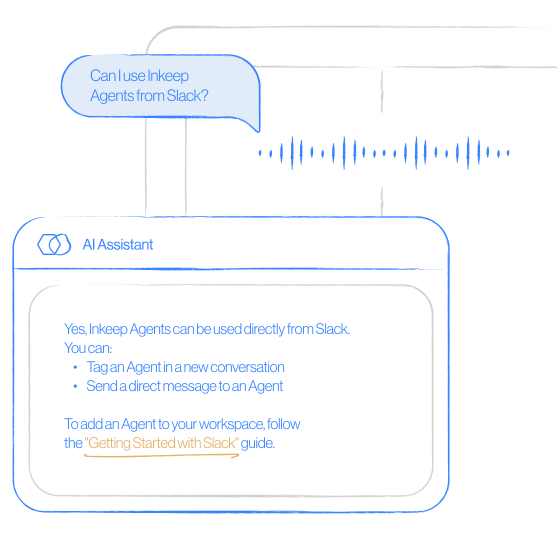
Does it integrate with our existing tools? For many teams, GitHub and Zendesk integration matters more than raw performance benchmarks.
-
Who can manage it? The best search is one that both developers and content teams can tune—not a black box that requires engineering cycles for every adjustment.
Frequently Asked Questions
Semantic search understands the intent behind a query, recognizing synonyms and related concepts (like 'single login' vs 'SSO'), whereas keyword matching only finds exact word overlaps.
Technical users need to verify code snippets and instructions. Citations provide a direct link to the source documentation, ensuring trust and traceability.
Analyzing searches that return 'no results' or low-relevance answers tells content teams exactly what information is missing from their documentation.