


AI B2B Customer Support in 2026: Automating Tier2/Tier3 work


Most support teams start with a chatbot and end up with a patchwork of AI tools that can't handle tier-2 or tier-3 work. Here's how agentic AI platforms consolidate fragmented tools and unlock automation for complex support workflows.
Agentic AI is increasingly smart enough to handle tier-2 and tier-3 workflows.
Here’s a story we see often at Inkeep: It starts when a Support leader rolls out a chatbot.
At first, deflection goes up. Teams see quick wins with AI adoption. Then every team wants more. Another AI vendor gets added. Before long, Support is managing a patchwork of fragmented tools.
Then the hard cases hit. Tier-2 and tier-3 work is the real test. It lives across tickets, logs, configs, internal systems, and approvals.
Here’s the problem: RAG can answer from knowledge. It cannot run an investigation across systems.
So the workflow stays manual, and progress stalls.
Agentic AI platforms solve this through 2 key unlocks:
- Consolidation of fragmented tools in one layer: Connect multiple tools in one layer and one interface using MCPs.
- Automation for individual team members: Cut the need to consistently log into multiple tools through one interface
The diagram below shows the shift.
The agentic layer sits above your tools: it retrieves knowledge, pulls account context, and executes steps across systems.
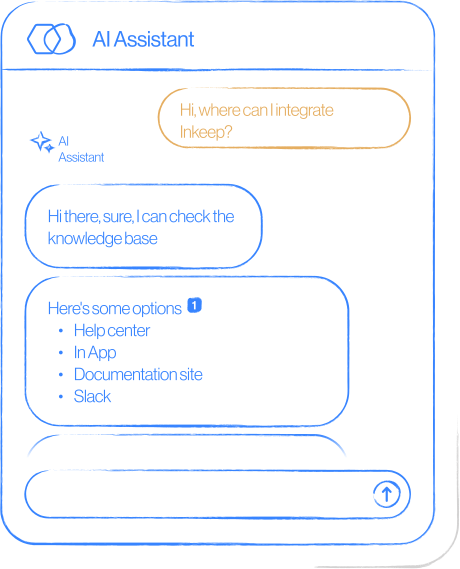
In practice, a rep chats with an agent that runs the steps across tools in the background.
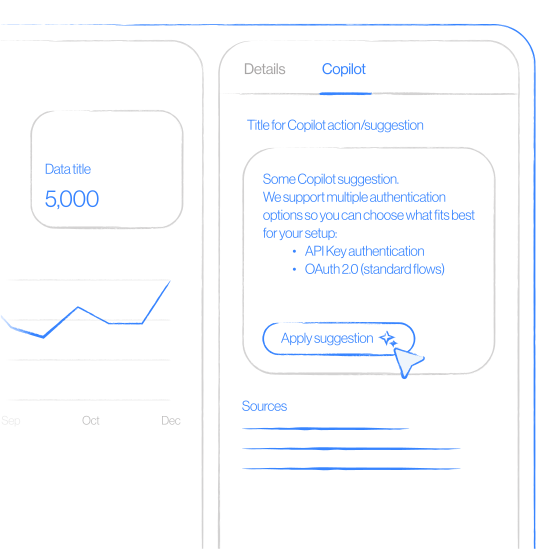
 Agent Copilot
As can be seen in the chat, you can keep your existing tools. The agent works across them in one workflow, reducing tool-hopping and cutting time to resolution.
3 tactical unlocks for support teams:
- Instant account-specific intelligence
- Quick enablement context for human teams
- Custom Agents for specialized tasks
3 Tactical Unlocks from Agentic AI in B2B Customer Support
Unlock 1: Account-Specific Intelligence
Context fetchers pull account-specific data from internal systems and combine it with product knowledge to answer for this customer, not a generic user.
When a customer asks, "Why is my invoice $X?", the system:
- Identifies the user and relevant context from the query
- Queries internal systems for that account’s pricing drivers (tier, usage, discounts, contract terms)
- Retrieves relevant pricing logic documentation
- Synthesizes an answer explaining why this user sees this pricing based on their configuration
This frees up time for Support teams by moving from generic explanations ("Here's how pricing works generally") to account-specific diagnosis ("Here's why YOUR pricing shows this value").
Unlock 2: Quick Enablement Context for Support Representatives
This is real-time capability for AI Support representative agents to have ‘Agentic’ capabilities across various systems with prompting. This reduces manual work involved in switching between multiple tools and saves mental bandwidth on context switching.
In this environment, the human support representative sees relevant case summaries across:
- Salesforce: Current case details, account info, subscription status, and full chat history
- Jira: Related bugs with similar symptoms or error patterns
- Documentation: Relevant troubleshooting guides for this error type
- Case history: Similar resolved cases with resolution notes
More mundane work is handled by AI (e.g. refund inquiries), and when escalated to customer support, the human agents immediately see comprehensive context without manual hunting across various systems. The orchestration happens in seconds to minutes, even for long-running cases.
This eliminates the "let me check and get back to you" workflow.
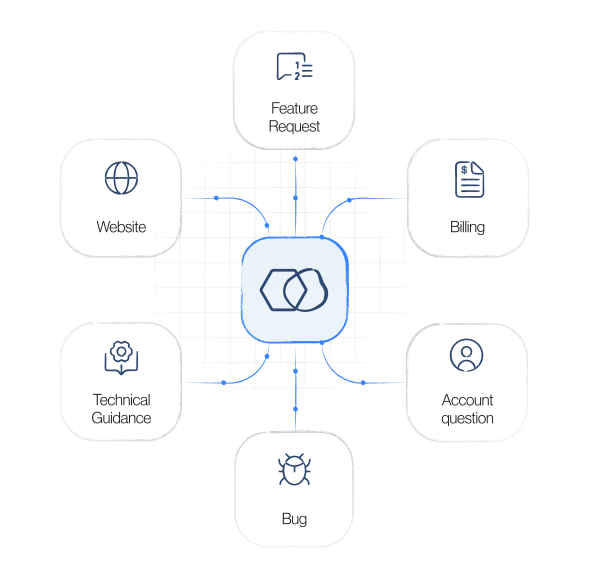
Unlock 3: Custom Agents for Specialized Tasks
The operational impact of this is significant. Support teams stop waiting for vendors to build the niche features they need. They build specialized agents themselves for workflows unique to their product, customer base, or operational model.
For example, this could include:
- Reporting agents: Analyze historical case data for specific customers, apply filtering criteria (time period, issue category, resolution status), identify trend patterns, generate insights for quarterly business reviews.
- Log analysis agents: Read error logs from customer environments, identify root causes by correlating error patterns with known issues, automatically create Jira tickets with diagnostic context and relevant code references.
- Troubleshooting agents: Combine product documentation with customer-specific configuration data to provide guided resolution paths. When a customer reports an integration error, the agent checks their specific integration settings, compares against documentation requirements, and identifies the misconfiguration.
Support operations can build workflows matching their competitive advantages rather than conforming to vendor templates.
How Executives Should View ROI with AI Agents
When AI now handles well-documented work that previously consumed support reps and engineers, those human resources can be redirected to work that compounds organizational value.
Therefore, organizations frame agentic AI value as strategic capacity reallocation:
- "Help our team avoid repetitive tasks so they can focus on novel, complex problems and helping customers".
- "Easy, answerable questions pull our senior engineers away from more complex, strategic work, which is an expense for our organization".
The ROI model shifts from cost reduction (handle more tickets with fewer people) to capacity building (e.g. reallocate senior engineer time from tier-1 documented questions to complex troubleshooting).
4 Patterns Inkeep is Seeing with Forward-Looking Organizations
Enterprise Support organizations evaluating Agentic AI platforms reveal consistent patterns in requirements and evaluation criteria.
Pattern 1: Platform Thinking Over Point Solutions
Organizations frame requirements as infrastructure decisions. This means platforms serving as support AI foundations for the next few years, capable of handling both standard tasks and complex agentic work as requirements evolve.
The evaluation question shifts from "Does this solve my problem today?" to "Can this platform grow with us as our AI sophistication increases?"
Pattern 2: Control & Customization
Organizations recognize their support workflows as competitive advantages. Forward-looking teams prioritize platforms with agent builders enabling orchestration and creation of niche, specific agents for workflows unique to their operations.
The requirement pattern: "Can I build a custom reporting agent that analyzes historical case data with my specific filtering criteria, or do I submit a feature request and wait for your roadmap?"
Pattern 3: Integration Depth Over Breadth
Integration depth determines production viability. API connections are table stakes - the differentiator is sophisticated orchestration handling real-world complexity like rate limits, timeouts, and context window management.
The evaluation question: "Show me this AI Agent orchestrating queries across three systems - Zendesk, Jira, our internal database - in a single agentic flow"
Pattern 4: Workflow Embedding as Adoption Requirement
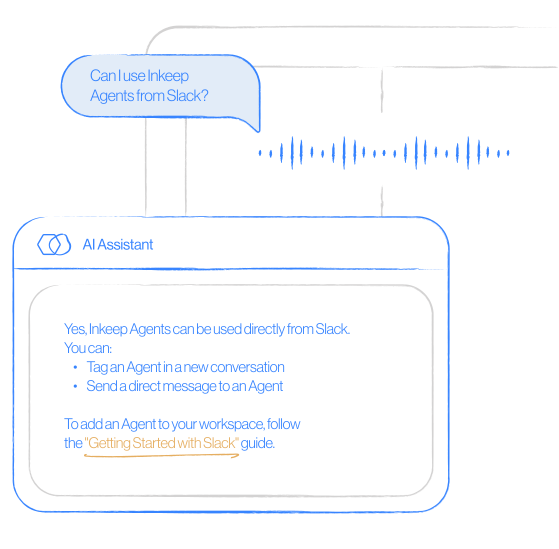
Successful AI operates where Customer Support already works. Organizations consistently identify workflow disruption as an adoption killer. Tools requiring teams to leave existing platforms (e.g. Salesforce, Slack) fail regardless of capabilities.
Forward-looking teams prioritize platforms that embed in existing platforms rather than forcing new tool adoption.
Why Inkeep's Agentic AI Platform Stands Out
We built Inkeep because we kept seeing the same patterns in how support organizations evaluated AI platforms. And the same architectural gaps cause implementations to underdeliver.
With Inkeep, B2B Customer Support teams get:
- Multi-agent orchestration
- Full control & customization to build agents for specialized workflows
- Confidence-based automation that protects brand reputation.
- AI embedded in existing tools
These requirements weren't edge cases - they represented the core operational needs that previous AI generations couldn't address. So we architected Inkeep around solving them.
This positions organizations for ecosystem evolution without vendor lock-in.
If these operational capabilities align with your support organization's requirements - custom agent building, multi-system orchestration, confidence-based automation, workflow embedding - we'd like to show you how Inkeep handles your specific workflows.
About the author

Frequently Asked Questions
RAG retrieves from a knowledge base to answer questions. Agentic AI can execute multi-step workflows across systems—querying internal databases, pulling account context, creating tickets, and synthesizing responses. RAG handles tier-1 deflection; agentic AI handles tier-2 and tier-3 work.
- Account-specific intelligence: agents pull account data to answer 'why is MY invoice $X?' instead of generic explanations. 2) Quick enablement context: agents surface case summaries across Salesforce, Jira, docs, and case history before a rep even opens a ticket. 3) Custom Agents: teams build specialized agents for reporting, log analysis, and troubleshooting—without waiting on vendor roadmaps.
The ROI model shifts from cost reduction (handle more tickets with fewer people) to capacity building—reallocating senior engineer time from tier-1 documented questions to complex troubleshooting and strategic work. Frame it as 'how much senior capacity is being freed up' rather than 'how many tickets were deflected.'
API connections are table stakes. The differentiator is sophisticated orchestration that handles real-world complexity: rate limits, timeouts, and context window management across systems. Require a demo of the AI Agent orchestrating queries across three systems—like Zendesk, Jira, and your internal database—in a single agentic flow.