


The Agent Rule System: How Support Teams Build Institutional Knowledge Into AI
Learn how support teams capture institutional knowledge by creating AI rules directly from resolved tickets. Implementation guide with decision framework.

SUMMARY
Enable agents to create rules mid-workflow—context fades fast.
Five accurate rules beat fifty brittle ones every time.
Two-way sync prevents ops and dev teams from fragmenting.
Gap analysis reveals tribal knowledge before it walks out.
Rule creation during resolution is the only sustainable capture point.
Decision
How can support teams capture and scale institutional knowledge through automated agent rules?
Enable agents to create rules directly from resolved tickets—turning one-off decisions into repeatable AI behavior.
Your best human agents see patterns generic automation miss.
They know which workarounds apply to version 3.2 vs 4.0. They recognize when a "billing question" is actually a permissions issue.
That expertise disappears when they leave.
The solution: rule systems that let agents program AI behavior mid-workflow. Research shows support automation delivers 210% ROI over three years with payback periods under six months. But that ROI depends on capturing the right knowledge: namely the tribal expertise your top performers already hold.
Decision Framework
Three capabilities separate platforms that capture tribal knowledge from those that just deflect tickets.
| Criterion | What to Look For | Why It Matters |
|---|---|---|
| No-code visual builder | Flowchart-style interface accessible to support ops, not just developers | Agents who solve tickets daily see patterns engineers miss—they need direct access to rule creation |
| Two-way sync between code and UI | Changes in visual builder update code automatically, and vice versa | Prevents tool fragmentation where ops and dev teams work in disconnected systems |
| Rule creation from live tickets | Agents can flag and create rules mid-workflow, not in separate sessions | Knowledge capture happens when context is fresh—waiting until documentation sprints means details get lost |
The third criterion matters most. When agents resolve a tricky ticket, they hold temporary expertise: the edge case, the workaround, the version-specific fix. Platforms requiring context switches to document that knowledge lose it.
Evaluate platforms by asking: can a support agent create a rule from the ticket they just resolved, without leaving their workflow?
Implementation Path
Start small. Teams that launch with 50 rules spend months debugging conflicts. Teams that start with 5-10 high-impact rules see faster adoption.
Phase 1: Pattern Identification (Weeks 1-2)
Pull your top 100 tickets by volume. Look for questions agents answer repeatedly with undocumented workarounds—these represent tribal knowledge that generic AI misses.
Gap analysis reports reveal exactly where documentation falls short based on real customer questions. Use these gaps to prioritize initial rule candidates.
Phase 2: Agent-Enabled Rule Creation (Weeks 3-4)
Enable agents to flag and create rules directly from resolved tickets. The agent who just solved a version-specific edge case is best positioned to codify that solution.
This isn't separate documentation work. Rule creation happens mid-workflow, capturing context while it's fresh.
Phase 3: Review and Sync (Ongoing)
Support leads review proposed rules for accuracy. Approved rules sync to the codebase, giving developers oversight without bottlenecking creation.
| Phase | Timeline | Owner | Output |
|---|---|---|---|
| Pattern ID | Weeks 1-2 | Support ops | 10-15 rule candidates |
| Rule creation | Weeks 3-4 | Frontline agents | 5-10 active rules |
| Review/sync | Ongoing | Leads + devs | Validated, versioned rules |
Five accurate rules that handle 30% of tickets outperform 50 brittle rules that create escalations.
How Inkeep Helps
Inkeep bridges support ops and engineering with a low-code studio paired with a TypeScript SDK. Changes sync both directions—ops teams build rules visually while developers maintain code-level control.
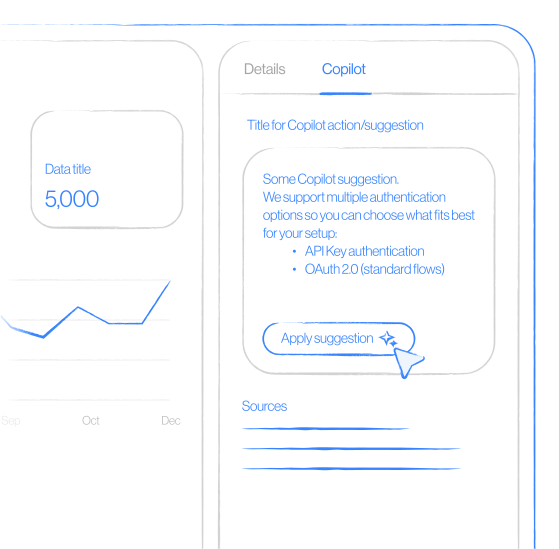
The Zendesk co-pilot lets agents suggest and refine AI answers during live ticket resolution. When an agent solves a tricky version-specific issue, they capture that knowledge immediately. Gap analysis surfaces undocumented patterns agents handle manually, identifying rule candidates before institutional knowledge walks out the door.
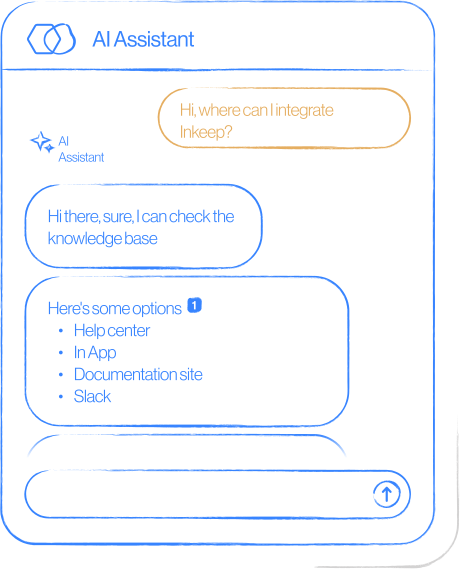
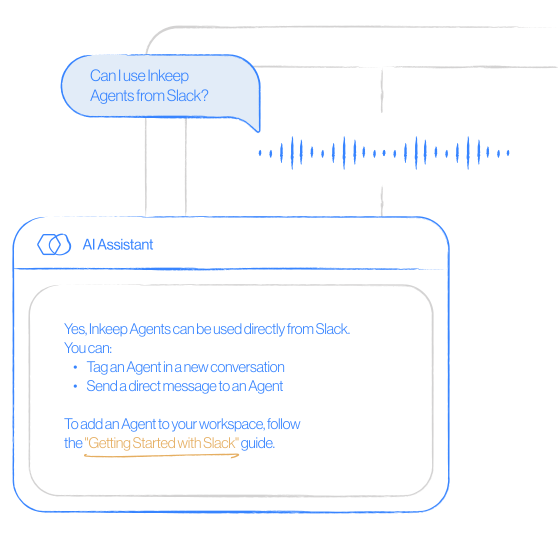
Every AI answer cites its sources. Agents verify accuracy before rules scale across thousands of tickets. This citation-backed approach powers support for enterprise teams—reducing escalations through answers teams can trust and audit.
Recommendations
For Support Directors: Start with gap analysis. Identify tickets where agents repeatedly solve problems undocumented elsewhere. Audit resolved tickets from your top performers before their expertise disappears.
For DevEx Leads: Evaluate two-way sync capability before committing. You need SDK access for version control and code review. Test both directions: UI-to-code and code-to-UI.
If you face high agent turnover: Prioritize platforms where rule creation happens during ticket resolution. Separate documentation sprints never happen—agents are too busy. The only sustainable capture point is the moment an agent solves a problem.
One compliance note: 71% of enterprises use AI without meeting SOC 2, GDPR, or EU AI Act requirements. Citation-backed AI answers create audit trails by design.
| Role | First Action | Success Metric |
|---|---|---|
| Support Director | Gap analysis audit | Rules created from top 10 undocumented patterns |
| DevEx Lead | Two-way sync test | Zero workflow breaks after SDK changes |
| Ops with turnover | In-workflow rule capture | Rules per resolved ticket ratio |
Next Steps
Your tribal knowledge is walking out the door with every agent departure. The question isn't whether to capture it—it's how fast you can start.
See the workflow in action. Request a demo focused on agent rule creation from live tickets. We'll use your actual knowledge base, not generic examples. You'll see exactly how an agent resolves a ticket, creates a rule, and syncs that knowledge to your AI.
The rule creation flow:
-
Agent resolves a complex ticket using tribal knowledge
-
Agent flags the resolution as a rule candidate
-
Support ops reviews and approves in the visual studio
-
Rule syncs to codebase for developer oversight
-
AI applies the rule to similar future tickets
Teams typically start with 5-10 high-impact rules and expand from there. The goal isn't automation volume—it's capturing the patterns your best agents already know.
Book your demo to see how your knowledge base becomes your AI's training ground.
Frequently Asked Questions
During ticket resolution—waiting loses critical context.
Five to ten high-impact rules, then expand based on results.
Requiring separate documentation sessions instead of in-workflow capture.
Prevents tool fragmentation between ops and engineering teams.