


Technical B2B Support in 2026: 4 Capabilities to Prioritize
Enterprise support leaders: prioritize these 4 AI capabilities for 2026—citation-backed chat, native integrations, inline sources, and smart guardrails.

SUMMARY
Citation-backed AI is table stakes—technical customers verify every answer.
Native integrations beat API wrappers; custom middleware becomes technical debt.
Guardrails route uncertain queries to humans before damage occurs.
Hallucinations destroy trust faster than slow responses ever could.
Evaluate AI support on four criteria: chat, integrations, citations, guardrails.
Decision
What technical support capabilities should enterprise leaders prioritize for 2026?
Four non-negotiables: AI chat grounded in your knowledge base, native Zendesk/Salesforce integrations, inline citations for every answer, and guardrails that escalate when confidence drops.
These aren't differentiators—they're table stakes. Technical customers expect instant, verifiable answers. They'll check your sources.
Citation-backed AI is already the default for companies that can't afford hallucination risk. Anthropic and PostHog require cited responses for customer-facing AI. By 2026, your customers will expect the same standard.
The gap between AI that answers and AI that proves its answers defines support quality. Here's how to evaluate each capability systematically.
Decision Framework
Use this rubric to evaluate any AI support platform. Each criterion separates solutions that work in demos from those that hold up in production.
| Criterion | What to Look For | Why It Matters |
|---|---|---|
| Product Expert Chat | Indexes internal and external docs; fully configurable tone, scope, and brand voice | Generic AI can't answer product-specific questions. Your chat must know your docs as well as your best support engineer. |
| Zendesk/Salesforce Integration | Native ticket creation, customer context in responses, workflow automation—not API wrappers | Teams waste time when tools don't sync. Native integrations eliminate manual handoffs and context-switching. |
| Inline Citations | Clickable source links, clear attribution, visible confidence scores | Technical customers verify answers. Citations let them—and your agents—confirm accuracy in one click. |
| Guardrails | Content filtering, confidence thresholds, automatic escalation to humans | AI should know what it doesn't know. Without guardrails, you trust the model to never confidently hallucinate. |
The trade-off: deeper capability means more setup time. But platforms lacking these features create ongoing maintenance debt. Custom middleware breaks, agents lose trust, and customers leave.
Prioritize solutions that handle all four natively. Bolting on citations or guardrails after deployment rarely works.
Why Citations and Guardrails Define Trust
Technical customers don't take AI answers at face value. They verify.
A developer troubleshooting an SDK integration checks your documentation before trusting an AI response. If the answer doesn't match—or cites a source that doesn't exist—you've lost credibility faster than a slow response ever could.
Hallucinations kill trust in ways that delayed tickets don't. A wrong answer confidently delivered creates support debt: the customer wastes time, returns frustrated, and questions every future AI interaction.
Inline citations solve verification friction. When every AI response links directly to source documentation, support agents confirm accuracy in one click. No tab-switching, no searching, no guessing. Teams see fewer escalations because agents verify answers instantly—reducing back-and-forth that drags resolution times into hours.
Guardrails aren't restrictions—they're routing logic. The goal isn't limiting what AI can say. It's knowing when AI shouldn't answer at all.
Confidence-based escalation catches the dangerous middle ground: queries where the model has enough context to generate a plausible response, but not enough to be accurate. Without guardrails, AI delivers wrong answers with conviction. With them, uncertain queries route to humans before damage occurs.
This matters most for technical B2B support. Your customers are engineers and developers who notice inconsistencies. Building trust means proving accuracy, not claiming it.
Platform Integration: Beyond API Wrappers
Native integrations determine whether AI support tools amplify your team or create parallel workflows.
The difference is operational: Native Zendesk and Salesforce integrations mean ticket deflection and agent assist happen in the environment your team already uses. API wrappers force agents to toggle between systems, copy context manually, and reconcile data across platforms.
What to look for:
- Automatic ticket creation from unresolved AI queries—no dropped conversations
- Customer context pulled into AI responses—account history, plan tier, previous tickets surface automatically
- Workflow automation triggered by query type, confidence score, or customer segment
What to avoid:
Solutions requiring custom middleware break when Zendesk or Salesforce push updates. You inherit maintenance burden instead of offloading it. If the integration can't survive a platform version change without engineering intervention, it's a liability.
Deeper integrations require more upfront configuration—field mapping, workflow design, permission structures. But this investment reduces ongoing maintenance and eliminates context-switching that drags resolution times.
Prioritize integration depth over speed-to-launch.
How Inkeep Helps
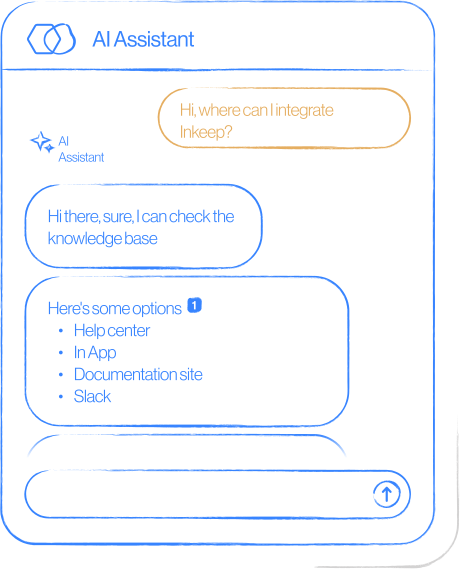
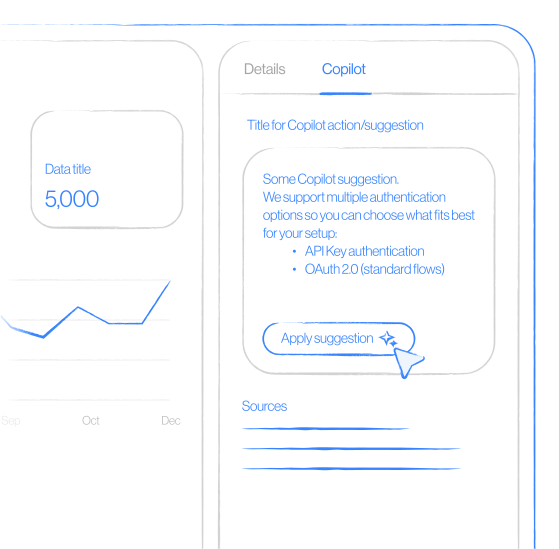
Inkeep delivers citation-backed AI support purpose-built for technical teams. The embeddable "Ask AI" chat bubble indexes your docs—internal and external—so customers get instant answers with clickable source links. Every response surfaces the exact documentation passage it drew from, letting customers and agents verify accuracy in seconds.
Native Zendesk integration means ticket deflection and agent assist happen inside your existing workflow. When confidence drops below threshold, built-in guardrails automatically escalate to human agents—no confident wrong answers reaching customers.
Inkeep powers support for Anthropic and PostHog—companies where hallucination risk isn't embarrassing, it's disqualifying.
Recommendations
For DevEx Leads: Prioritize SDK flexibility over drag-and-drop simplicity. Look for platforms offering TypeScript control alongside low-code config. Locked-in tools become technical debt fast.
For Support Directors: Start with gap analysis reports before deploying AI. Identify content gaps first, then AI routes intelligently instead of guessing.
For Technical Founders: Make citation-backed responses non-negotiable from day one. Your technical customers verify answers—they notice missing sources.
If you need fast deployment: Choose an out-of-box Zendesk co-pilot over custom builds. Native integrations ship in days. Custom middleware takes months and breaks on platform updates.
| Role | First Priority | Avoid |
|---|---|---|
| DevEx Lead | SDK + low-code flexibility | Vendor lock-in |
| Support Director | Doc gap analysis | Launching blind |
| Technical Founder | Citation requirements | Hallucination-prone tools |
| Fast deployers | Native integrations | Custom middleware |
Next Steps
Your 2026 support stack depends on one decision: Will your AI earn customer trust or erode it?
The capabilities outlined here—citation-backed responses, native platform integrations, and confidence-based escalation—separate tools that deflect tickets from tools that actually resolve issues.
- Request a Demo — See citation-backed AI answer questions from your actual knowledge base
- Download the Evaluation Rubric — Use our framework to assess any platform against these four criteria
Technical customers verify every answer your AI gives. Make sure those answers cite their sources.
Frequently Asked Questions
They verify AI answers against source docs before trusting them.
They survive platform updates without engineering maintenance work.
When confidence drops below threshold on uncertain queries.
Anthropic and PostHog mandate cited customer-facing AI.