


"The Foundation of Automation": Why Modern CX Leaders Are Prioritizing Knowledge Governance


Mark McKercher (Sovos Compliance) on why the real AI opportunity in support isn't headcount reduction—it's governance, redeploying talent, and turning support into a retention and growth engine.
Support is evolving from reactive entry-level roles to strategic technical careers—AI accelerates this shift by raising the ceiling on role depth and expertise.
As organizations build AI strategies, a familiar pattern shows up in support: too much hype, too little operating model.
Everyone wants "automation." Few leaders want to talk about the unglamorous work behind it—governance, cross-functional capacity planning, and measuring outcomes beyond cost.
That gap is exactly where enterprise CX leaders can step up.
I recently sat down with Mark McKercher, a CX and support leader at Sovos Compliance, to unpack what's actually changing in support and what leaders should do about it.
"We need to let go of this notion that we're going to be able to just eliminate human costs… [and focus] more on where can we redeploy humans… to be more effective to drive better outcomes."
That's the thesis. Not "AI will make support cheaper." AI will force support to become more strategic—and the leaders who treat it that way will win.
Support is a strategic career path
Mark described a shift that a lot of seasoned leaders feel, but don't always name clearly: support used to be treated as an entry-level, reactive function."25 years ago, support was a really reactive role… people either starting out in their careers or just sort of as a transient sort of role."
Today, support is increasingly a place where people build real careers—because the work is getting more technical and more connected to how the company runs. "We've got people that are looking to really develop their career… and they can do that from support."
AI is accelerating that shift by raising the ceiling on how deep support roles can go. "We've got an opportunity now through AI and automation to create people that have much deeper technical expertise."
If you're a VP of Support or CCO, this matters for one reason: your talent strategy must evolve. That's because the job is turning into something closer to a technical, cross-functional leadership pipeline.
And while the function is changing, Mark was clear that the fundamentals of leadership haven't magically changed with the tooling. "Leading with empathy… clarity around expectations and a mission… [and] being consistent about holding people accountable… those things have stayed true."
In essence, the human side isn't going away, but the bar is moving up.
AI success is not a tooling problem
One of the most practical moves Mark made was structural: he created a dedicated function focused on AI execution and governance. "I've built out a new vertical focused exclusively on AI and governance"
And he's explicit about what that team actually does: it's not "innovation theater." It's the foundation work that makes automation and self-service real. "What they're focusing on is really the foundation… driving automation and self-service for the support experience."
The real AI initiatives, according to Mark, are, for example, defining ownership, or building cross-functional capacity..
Mark called out the coordination burden directly:
"That includes… coordinating with our internal applications teams, the product teams, to figure out how do we ingest the chatbot appropriately… not only on our support portal, but also in the product."
And he shared a mistake that will sound painfully familiar to anyone who has tried to implement AI in an enterprise environment: "We've realized we didn't give [the team] that owns Salesforce… enough heads up… with how much time we need from them to implement this technology."
This is why "AI in support" isn't just a support initiative, but rather a workflow redesign initiative that touches:
- systems of record (CRM / case management),
- product experiences (in-app),
- knowledge sources (docs and policy),
- and governance (who owns what, and what's allowed).
This is where change management becomes critical.
Start with the boring wins
Mark's view on "quick wins" is refreshingly grounded: start where value is obvious and the blast radius is manageable.
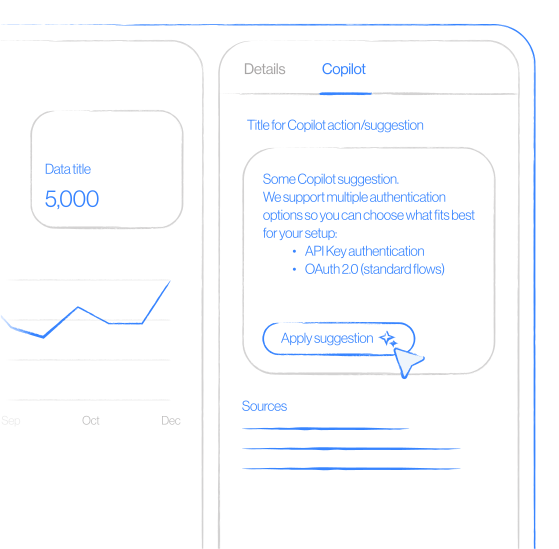
First: copilots inside the ticket workflow to gain operational leverage.
"The easiest thing to do quickly is… have a copilot integrated with your support ticket… to summarize large sets of data… [and] very quickly… bring an analyst up to speed."
And for leaders, it's a great forcing function: you can align teams on what "good" looks like (clarity, consistency, speed) without pretending you're ready for full automation.
Second: use AI to drive knowledge generation and prioritization."Using AI to help you with where you need to focus on knowledge generation is another really big area of quick win…"
Mark framed knowledge generation as a strategic flywheel. "The knowledge generation… is the foundation of your bot and foundation of your automation. So it's sort of a virtuous cycle."
For Mark as Sovos' VP of Customer Support, this meant an AI solution for finding documentation gaps and drafting updates on Product Documents.
"We had our AI solution go in and look at… six months worth of all of our tickets… and then… look at all of our product documentation… and… show us where the gaps were…"
That's the part most teams skip: connecting what customers ask to what your company documents. And the output was hundreds of articles drafted in 6 months.
If you're accountable for ROI, this is gold. It turns knowledge from "nice-to-have" into demand-driven enablement.
Redefine Roi: Redeploy Talent, Expand Capacity, And Make Support A Retention Lever
This might be the most important idea in the whole conversation: stop selling AI internally as cost-cutting.
Mark put it bluntly: "We need to let go of this notion that we're going to be able to just eliminate human costs, like with a snap of a finger."
Instead, he's pushing leaders to think about redeployment and outcomes."It [should] be more on where can we redeploy humans… to be more effective"
This is where many support organizations struggle with executive storytelling—because "we're better" isn't a metric.Mark called out the measurement problem directly: "What I think leaders really need to be thinking about is how do you measure that more?"
And he gave a concrete version of the board-level narrative: "My P&L was X million last year and it's going to be X million next year too, but guess what? We're going to get all this more…"
What's the "more"? Retention, churn reduction, and customer outcomes for the same amount of dollars spent. "We're going to be a key catalyst to retaining customers and driving down churn… support can start stepping up there as well…"
He also sees support as a growth lever for revenue. His example was simple and very real in enterprise environments—removing humans from low-risk transactional workflows and measuring conversion.
"We're going to be able to start measuring the throughput of the sales of those products without having humans involved… that's definitely going to be a revenue generator…"
If you lead support, this is the opportunity: own the narrative shift.
Support already touches the most customers. "We touch the most customers on a day-to-day basis… and… we have the largest repository of customer data". This is an advantage that is amplified with AI when operationalized into an advantage.
Taking Strategic Ownership
If you're trying to cut through the AI noise and lead with credibility, here are 3 actions for this quarter that map directly to what Mark has seen work.
-
Stand up an "AI & governance" lane with real cross-functional ownership
- Use Mark's framing and make it explicit: "a new vertical focused exclusively on AI and governance."
- Define who you need at the table early (CRM owners, product, security, enablement).
- Bake in capacity planning up front.
-
Ship ticket copilot in the agent workflow—then measure adoption like a change program
- Anchor on the simplest, highest-confidence value: "bring an analyst up to speed" via summarization.
- Don't stop at rollout. Track:
- adoption by team/tenure,
- time-to-context (how quickly agents understand a case),
- and quality signals (reopens, escalations, handoffs).
- Treat it as behavioral change, not a plug-in.
-
Turn knowledge into a demand-driven system (not a documentation project)
- Analyze existing customer conversations and compare them documentation
- Prioritize by frequency and customer impact
- Use his north star: "knowledge generation… is the foundation of your bot," so every knowledge investment is also an automation investment.
About the Interview
This post is based on a recorded conversation with Mark McKercher (Sovos Compliance), interviewed by the Inkeep Team on the Inkeep podcast. The discussion focused on how enterprise support organizations should think about AI through the lenses of governance, change management, knowledge strategy, and measurable business outcomes.