


Interactive Docs: The New Competitive Edge for DevTools in 2026


Learn how to implement RAG-grounded AI chat for developer documentation. Decision framework, phased implementation path, and role-based recommendations.
Generic chatbots hallucinate—only RAG-grounded AI with citations delivers trustworthy answers.
Decision
How should we evolve our documentation from static content to interactive AI-powered experiences that developers actually use?
Add RAG-grounded AI chat with citations. Generic chatbots hallucinate with alarming fluency. Purpose-built solutions that cite sources deliver value; everything else creates liability.
Engineers using AI daily reach onboarding milestones nearly twice as fast. But speed without accuracy backfires.
In conversations with DevEx leaders, one theme emerges consistently: a bad AI assistant that wastes developers' time is significantly worse than no assistant at all.
Three requirements separate useful from dangerous:
-
Purpose-built for technical content—not generic support AI
-
Citable answers—every response links to your knowledge base
-
Feedback loops—real questions reveal documentation gaps
Static docs broadcast information. Interactive docs respond to individual developer contexts.
Decision Framework
Not all interactive docs solutions deliver equal value. RAG has matured into a core building block for any serious AI system, but implementation quality varies wildly.
Use this framework to evaluate platforms:
| Criterion | What to Look For | Why It Matters |
|---|---|---|
| MCP Server Support | Explicit Model Context Protocol implementation, standardized tool interfaces | Enables IDE integrations and agentic workflows without custom builds |
| Agent Traces + OpenTelemetry | Visual trace interfaces, exportable telemetry, step-by-step decision logs | Debug AI reasoning when answers go wrong; measure retrieval quality |
| Citation Coverage | Verifiable source links on every response, one-click verification | Builds trust; support teams validate before sending to customers |
| Hallucination Controls | Confidence scoring, retrieval thresholds, explicit "I don't know" responses | Prevents AI from guessing with radical overconfidence |
| Escalation Paths | Automatic handoff triggers, low-confidence routing rules | Humans catch what AI misses before it reaches customers |
Prioritize citation coverage and trace visibility first. These capabilities let you audit AI behavior and course-correct before small issues compound.
Implementation Path
You don't need to rebuild your documentation from scratch. A phased approach lets you prove value at each step.
Phase 1: Bolt-on Chat
Add an AI assistant grounded on your existing knowledge base. No content migration required—just point the RAG engine at your current docs, API references, and guides.
Companies with AI-powered knowledge bases report 35% reduction in support volume. You'll see results within weeks, not quarters.
Phase 2: Gap Analysis
Every question your chat can't answer reveals a documentation gap. Track patterns: Which SDK methods generate the most confusion? Where do developers abandon the chat and file tickets instead?
Gap analysis shows exactly where docs fall short based on real customer questions—not guesses about what developers might need.
Phase 3: Headless Docs via MCP
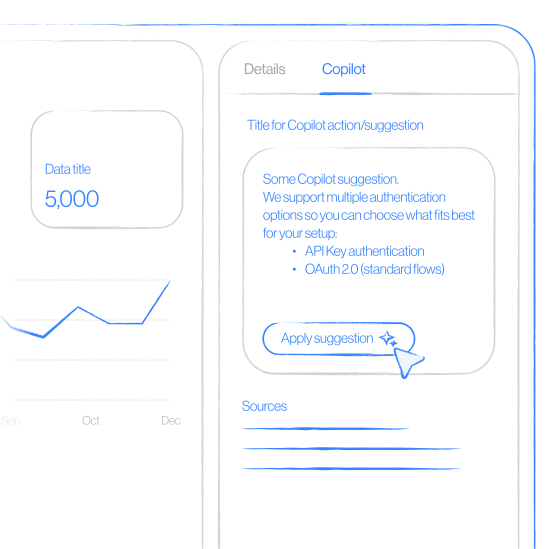
Expose your documentation as a tool for developer IDEs and workflows. MCP server support means your docs become callable context for any AI coding assistant. Agent traces and OpenTelemetry compatibility let you debug exactly how AI decisions flow from question to answer.
| Phase | Effort | Impact |
|---|---|---|
| Bolt-on chat | Days | Immediate deflection |
| Gap analysis | Weeks | Data-driven content prioritization |
| Headless docs (MCP) | Months | IDE-native documentation |
The trade-off: Phase 1 delivers fast wins but limited insight. Phase 3 requires infrastructure investment but transforms docs into a developer tool.
Why General-Purpose AI Fails for Technical Docs
Three categories of tools promise to help developers find answers. All three fail for technical documentation.
Ungrounded LLMs hallucinate with dangerous confidence. Ask a generic LLM about your API's rate limits, and it will answer authoritatively—even when fabricating details. For API references where a wrong endpoint crashes production, confident fiction is worse than no answer.
Keyword search matches terms, not intent. Traditional search excels at finding documents containing specific words. But developers ask questions: "How do I retry failed webhooks?" not "webhook retry configuration."
Generic support AI lacks technical depth. Consumer-facing AI handles "Where's my order?" well. It struggles with "Why does my SDK throw a 403 when I pass a valid JWT?" These platforms weren't built for code examples or debugging workflows.
The trade-off is real: generic tools deploy faster but sacrifice accuracy. Purpose-built RAG delivers verified answers but requires upfront investment in grounding.
How Inkeep Helps
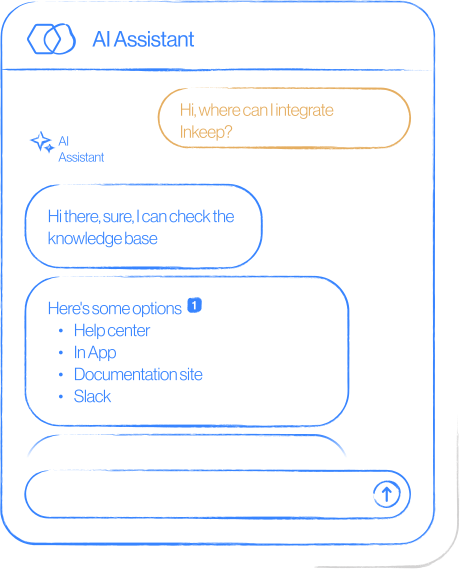
Inkeep's RAG engine grounds every answer in your actual knowledge base—not generic training data. Customer-facing AI chat surfaces answers with citations, so support agents verify claims in one click.
The platform also bridges ops and engineering workflows:
-
Low-code studio lets ops teams configure behavior without waiting on dev cycles
-
TypeScript SDK gives developers full control when they need it
-
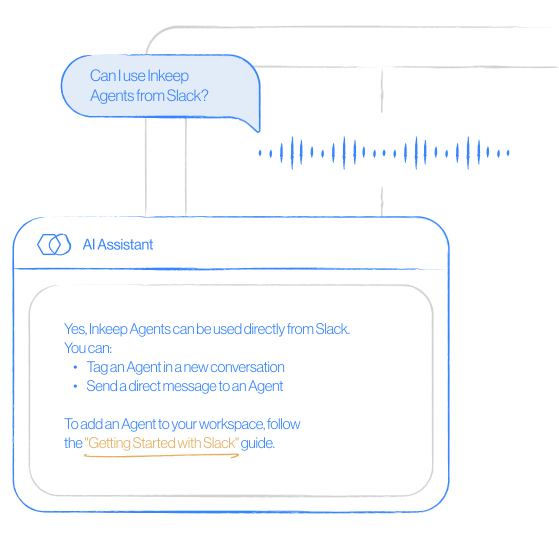
MCP server integration exposes your docs as callable context for AI coding assistants
-
Agent traces via OpenTelemetry debug AI decisions and audit answer quality at scale
Inkeep powers support for teams where developer trust depends on accurate, citable answers.
Recommendations
Your path forward depends on your role and current docs maturity.
For DevEx leads: Start with bolt-on chat to measure question patterns before deeper integration. You'll learn what developers actually struggle with. 58% of organizations consider developer experience key to improved productivity.
For Support Directors: Prioritize citation coverage above all else. Agents need verification, not guessing. Every answer should link to a source they can check in one click.
If you need MCP support: Evaluate trace interfaces and OpenTelemetry compatibility upfront. These integrations determine whether your AI chat works inside developer IDEs or stays siloed in a browser tab.
If docs quality is unknown: Run gap analysis first. Real user questions reveal content holes faster than any audit.
Next Steps
Ready to see interactive docs in action? Request a Demo to See RAG-grounded AI chat in your environment
Frequently Asked Questions
Yes—but only with RAG-grounded AI that cites sources.
Bolt-on chat over existing docs delivers results in days.
It lets teams verify AI claims in one click, building trust.
It lacks code context and hallucinates API details confidently.