


Building AI Support for Slack-First Teams: A Complete Guide


Your developers live in Slack, but your support knowledge lives everywhere else. Learn how to build AI support that meets developers where they already work.
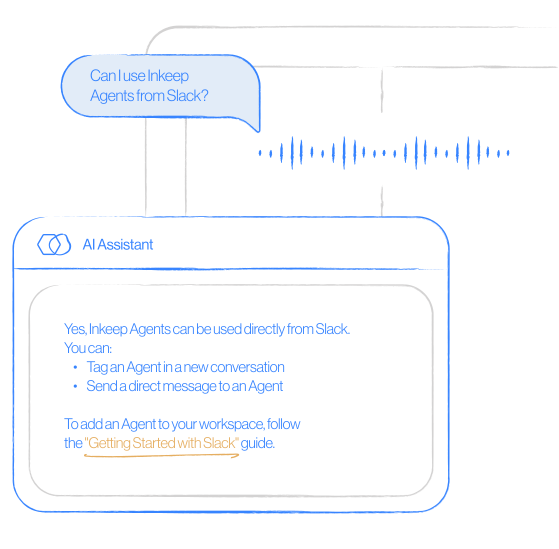
Slack-first support reduces context switching and tribal knowledge silos by meeting developers where they work
Your developers live in Slack, but your support knowledge lives everywhere else—docs, Zendesk, Notion, GitHub. At Inkeep, we see this a lot and the typical outcome is that engineers ping each other instead of searching, and tribal knowledge stays tribal.
This guide walks through building AI support that meets developers where they already work, with citations they can actually trust.
Why Slack-First Support Requires a Different Approach
Traditional support architecture assumes customers will come to you. You build a help center, embed a chat widget, set up a ticket portal, then wait. But technical teams use Slack, which is there communication hub they never leave, but it wasn’t carefully designed for customer support.
The cost of this mismatch shows up in interruptions. Developers ping colleagues because searching docs feels slower than asking someone who "just knows." Even when documentation exists and is technically excellent, the friction of switching contexts—leaving Slack, opening a browser, navigating to docs, formulating a search query, parsing results—often exceeds the social cost of tapping a teammate on the shoulder.
The question "hey, quick one, how do I configure webhooks again?" takes ten seconds to type. Finding the answer in docs might take two minutes. Multiply that calculation across an engineering org, and you get a culture where tribal knowledge stays tribal and documentation goes stale from underuse.
In comes Slack-native AI support. This is AI-enabled support in slack to reduce mean time to resolution by eliminating the "where do I even look?" friction entirely. When the AI lives where the questions already happen, adoption becomes a non-issue.
In conversations with platform engineering teams, we've observed that Slack-integrated AI support sees faster uptake than standalone chat widgets precisely because there's no behavior change required. Developers don't need to remember to check a different tool; they just ask in the channel they're already in.
There's also an architectural difference that matters: Slack interactions are conversational and threaded, not single-query transactions. Someone asks about authentication, gets an answer, then follows up with "what about for the Python SDK specifically?" Your AI needs to handle that follow-up naturally, understanding that "what about" refers to the previous context—not treat it as a brand new, context-free query.
Understanding why Slack-first matters is step one. Now let's look at what you actually need to build interactive AI support that goes beyond a basic bot.
Core Components of Interactive AI Support in Slack
Building a Slack bot that responds to messages is straightforward. Building one that engineers actually trust requires five distinct architectural components working together.
1 — Knowledge base connectivity. Your AI needs read access to everything your team knows—documentation, runbooks, past support tickets, and ideally code repositories. RAG (retrieval-augmented generation) is the pattern that makes this work without expensive fine-tuning. Instead of training the model on your content, you retrieve relevant chunks at query time and include them in the prompt. This keeps answers grounded in your actual documentation rather than the model's general training data. Research indicates that RAG-grounded systems can reduce hallucination rates by up to 50% compared to generic LLM responses Gartner.
2 — Citation infrastructure. In technical environments, an answer without a source is just a suggestion. Every response needs clickable citations so engineers can verify accuracy or dive deeper into context. This isn't optional polish—it's what separates useful AI from a liability. Inkeep's RAG engine cites every answer from your knowledge base, which is why technical companies building customer-facing AI rely on this architecture pattern.
3 — Thread-aware context. Slack conversations don't happen in single exchanges. When someone asks a follow-up question, your AI needs to understand whether "what about the async version?" refers to the previous answer or starts a new topic entirely. This requires maintaining conversation state within threads while knowing when to reset context.
4 — Escalation paths. The AI should recognize its own limitations. When confidence is low or the question requires human judgment, it needs to hand off gracefully—and preserve the full conversation context so no one has to repeat themselves. In conversations with enterprise teams, one technical leader noted that the inability to connect tools in a unified way creates friction that kills adoption.
5 — Feedback loops. Thumbs up/down ratings are table stakes. Real signal comes from tracking which answers get clicked through to source docs, which get escalated despite high confidence, and which questions consistently have no good answer. That last category is gold—it's your roadmap for documentation improvements.
Handling Multi-Turn Conversations and Edge Cases
Getting answers into Slack is one thing. Handling the way real conversations actually unfold is another challenge entirely.
Consider this scenario: a user asks about authentication, your AI responds with OAuth setup instructions, and then the user follows up with "what about for the Python SDK specifically?" A naive implementation treats that as a brand new query—searching for "Python SDK specifically" and returning something useless. A well-architected system understands that "what about" refers to authentication and scopes the response accordingly.
Thread context windows are your friend—until they aren't. You need to preserve enough conversation history that follow-up questions make sense, but letting context grow unbounded creates two problems: inference costs increase linearly, and relevance degrades as the model tries to juggle too much information. Most teams find that 3-5 previous turns strikes the right balance for technical support conversations. Beyond that, users typically either have their answer or need to escalate anyway.
Graceful degradation matters more than perfect answers. Research shows that users abandon conversations at significantly higher rates when AI gives confidently wrong answers versus when it acknowledges uncertainty Nielsen Norman Group. The difference is trust. When your AI doesn't have a good answer, it should say so clearly: "I don't have documentation on custom SAML configurations—would you like me to escalate this to the integrations team?" That's infinitely better than hallucinating a plausible-sounding but incorrect setup guide.
Ambiguity requires clarifying questions, not guesses. "How do I set up webhooks?" could mean event subscriptions, outbound notifications, signature verification, or retry configuration depending on where the user is in their implementation. Rather than picking one interpretation and hoping, train your system to ask: "Are you looking to receive events from our platform, or send data to an external endpoint?"
Finally, build an edge case library. Every query that stumps your AI—every escalation, every thumbs-down—goes into a running list. Gap analysis reports transform these failures into a concrete roadmap, showing exactly which questions your documentation doesn't answer well. This is how teams turn "the AI couldn't answer that" into documentation improvements that compound over time.
Handling conversations well is about user experience. But measuring success is about proving value to the organization—and knowing where to invest next.
Measuring Success: Beyond Deflection Rate
Deflection rate has become the default metric for AI support, but it's fundamentally a lagging indicator. It tells you what happened—not why it happened or how to improve. Worse, optimizing purely for deflection can incentivize the wrong behaviors: AI that confidently answers incorrectly still "deflects" the ticket, at least until the frustrated user escalates anyway.
The metrics that actually drive improvement are leading indicators tied to answer quality and user behavior.
Answer acceptance rate measures whether users engage with the AI's response. Did they click the citation? Did they copy the code snippet? A high deflection rate paired with low acceptance suggests users are abandoning the interaction, not finding resolution.
Follow-up rate reveals answer completeness. If one query resolves the issue, your AI is doing its job. If users consistently need three or four exchanges to get what they need, you have a retrieval or synthesis problem worth investigating.
Escalation context quality is often overlooked. When humans do take over, do they have the conversation history and relevant context? Or are users repeating themselves? In conversations with enterprise support teams, this handoff friction is one of the most common complaints—the AI interaction created work rather than reducing it.
Documentation health metrics flip the perspective from AI performance to content performance. Which topics generate the most queries? Which have the lowest answer confidence scores? Where are users asking questions that simply have no matching content? These gaps are your roadmap for documentation investment.
Time-to-resolution comparison measures the full journey. Does Slack-native support actually reduce total resolution time compared to the ticket-based alternative? This requires measuring from first question to confirmed resolution, not just AI response time.
Finally, build in qualitative review. Sample escalated conversations monthly and look for patterns. Are there entire topic areas—authentication, billing, specific SDK versions—where AI consistently fails? These clusters often reveal systematic gaps that quantitative metrics miss.
Companies using Inkeep see fewer escalations and faster customer onboarding, but the real value compounds over time: visibility into exactly where your knowledge base falls short turns reactive support into proactive improvement. Inkeep’s docs writer and gap analysis agents do this.
Measurement closes the loop—but only if you act on what you learn. Let's wrap with a practical framework for continuous improvement.
Building a Feedback Loop That Actually Improves Over Time
The difference between AI support that stagnates and AI support that compounds in value comes down to one thing: whether you've built a systematic way to learn from every interaction.
Establish a Weekly Review Rhythm
Designate an owner—typically a DevEx lead or support director—to review gap reports and triage documentation improvements. This isn't a "when we have time" task; it's a recurring calendar block. Without clear ownership, gap reports become another dashboard nobody checks.
The review should answer 3 questions: What questions stumped the AI this week? Which topics had the lowest answer confidence? And which gaps are worth fixing versus edge cases you can live with?
Make Wins Visible
When the AI couldn't answer something last month and now it can, announce it. This seems small, but it's how you build organizational trust in the system. Engineers who tried the AI early and got a bad answer won't try again unless they have a reason to. Visible improvements give them that reason.
Inkeep's gap analysis reports surface real customer questions that your docs don't answer well—this turns reactive support into proactive documentation strategy. Instead of waiting for tickets to pile up on a topic, you see the gap forming in real time.
Route to the Right Contributors
Not every gap needs the same fix. Some require technical writers to clarify existing content. Others need engineers to update code samples or add missing endpoints. Some need product to clarify intended behavior that was never documented.
Build a simple triage framework: content gaps go to docs, code gaps go to engineering, behavior gaps go to product. Without routing, everything lands on one person who becomes a bottleneck.
Version Your Knowledge and Plan for Model Updates
When docs change significantly, monitor whether AI answer quality changes with them. Sometimes well-intentioned documentation "improvements" actually degrade retrieval quality—restructured pages, renamed sections, or consolidated articles can confuse the AI's citation mapping.
Similarly, if you're using third-party AI infrastructure, model updates can shift behavior unexpectedly. Maintain a test suite of common queries and run it after major updates.
Key Takeaways
Interactive AI support in Slack isn't a set-and-forget project. But with the right architecture and feedback loops, it becomes a system that gets smarter as your product and customers evolve.
The three things that matter most:
- Designate clear ownership for gap review
- Make improvements visible to rebuild trust
- Route fixes to the right contributors so nothing bottlenecks
If you're evaluating AI support for a Slack-first team, Inkeep's SDK and low-code studio are built for exactly this use case—technical companies that need citations, flexibility, and visibility into where their docs fall short. Explore the documentation or see how leading AI and developer tools companies use Inkeep for customer-facing support.
For teams ready to talk specifics, book a demo
The best AI support systems don't just answer today's questions—they systematically eliminate tomorrow's.
Research Sources
Frequently Asked Questions
Technical teams live in Slack. Slack-first support reduces context switching friction, preventing interruptions and increasing documentation adoption compared to traditional help centers.
Reliability requires five components: Knowledge base connectivity (RAG), citation infrastructure, thread-aware context, graceful escalation paths, and feedback loops for improvement.
Move beyond deflection rates to leading indicators: answer acceptance rate, follow-up rate, escalation context quality, and documentation health metrics.
Use failures as data. Implement weekly gap reviews to identify missing content and route fixes to documentation, engineering, or product teams to continuously improve the system.