


AI Ticket Summarization: End Manual CAN Reports in 2026


Eliminate manual CAN reports with auto-updating AI summaries. Learn the 3 criteria that separate effective tools from point-in-time gimmicks.
Manual CAN reports decay the moment a customer replies.
Decision
How can we eliminate manual ticket summarization and maintain context during support escalations?
Auto-updating AI summaries regenerate structured context on every ticket change, making manual summarization obsolete.
Manual summaries decay the moment a customer replies. The CAN report you wrote three messages ago no longer reflects reality.
This causes a specific, measurable problem: engineers spend 2-4 hours per escalated ticket—$200-$500 in engineering time—reconstructing context from stale information. Of the typical 18-hour resolution time, 6+ hours are tickets bouncing back because receiving teams lacked complete information.
The fix isn't better discipline or stricter templates. It's removing the manual step entirely.
Teams that implement continuous summarization eliminate context reconstruction at handoffs. But how do you evaluate whether an AI summarization solution actually solves the context-loss problem?
Decision Framework
Not all AI summarization tools solve context loss. Most generate point-in-time summaries that decay immediately.
Use these three criteria to separate effective solutions from feature-checkbox gimmicks:
| Criterion | What to Look For | Why It Matters |
|---|---|---|
| Platform Integration | Native sidebar in Zendesk/Salesforce—not separate tabs or browser extensions | Summaries agents must hunt for don't get used under volume pressure |
| Inline Citations | One-click links from summary claims to source messages | SMEs won't trust AI summaries they can't verify in seconds |
| Guardrails | Confidence scoring plus auto-escalation flags for edge cases | AI that confidently hallucinates causes worse handoff failures than no summary at all |
Platform integration is non-negotiable. Generic AI tools focus on deflection metrics while ignoring that escalations fail at structural breakpoints—context lost in transitions between teams and tools.
Inline citations address the trust gap. Enterprise ops leaders consistently report that teams waste time verifying AI-generated context during SME escalations. One-click verification eliminates this friction.
Guardrails prevent the worst outcome: AI-generated misinformation in escalation handoffs. When summarization confidence drops—new product areas, ambiguous issues—the system should flag for human review, not guess.
Why Manual CAN Reports Fail
CAN reports—Context, Action, Needs—sound great in training. In practice, they decay after the first customer reply.
Every new message invalidates the previous summary. Agents know this. Under volume pressure, they skip updates entirely.
The math explains why. If time-to-escalate is 4 hours versus 15 minutes, agents are spinning wheels on issues beyond their scope. Those 4 hours aren't problem-solving—they're context reconstruction.
Stale summaries create a cascade failure:
When a receiving agent inherits a ticket with outdated context, they face two options: trust the summary and risk working from fiction, or re-read the entire thread. Most choose the thread. That adds 15-30 minutes per escalation.
Multiply that across 50 escalations per week. You've lost 12-25 hours of engineering capacity to reading emails—not solving problems.
Current AI summarization tools don't solve this. Many existing tools, including Zendesk AI, require manual triggering. That's the same discipline problem repackaged.
Implementation Path
Three phases separate pilot projects from production-ready summarization. Most teams complete all three within 4-8 weeks—with measurable cost-per-ticket improvements of 20-40%.
Phase 1: Connect AI to Your Ticket System
Grant read access to full conversation history in Zendesk or Salesforce. The AI needs every reply, internal note, and attachment reference—not just the latest message.
This isn't optional. Point-in-time summaries that miss thread context are why existing tools fail.
Phase 2: Configure Structured Regeneration
Define your summary format: Context, Actions Taken, Blockers, Recommended Next Steps. Then set the trigger: regenerate on every ticket update.
This is the critical difference. Manual CAN reports decay the moment a customer replies. Auto-regenerating summaries stay current without agent intervention.
| Summary Component | What It Captures | Why It Matters |
|---|---|---|
| Context | Customer issue, environment, impact | Receiving agent skips thread archaeology |
| Actions Taken | Steps attempted, results | Prevents duplicate troubleshooting |
| Blockers | What's preventing resolution | Surfaces escalation triggers immediately |
| Next Steps | Recommended path forward | Reduces handoff decision time |
Phase 3: Set Confidence Thresholds
AI can't reliably summarize everything. New product areas, ambiguous multi-issue threads, and edge cases need human review.
Configure thresholds: when confidence drops below your benchmark, flag the ticket for manual verification before escalation. This prevents bad summaries from creating new problems.
The goal isn't 100% automation. It's removing the 80% of manual summarization that agents skip under volume pressure anyway.
How Inkeep Helps
Inkeep addresses all three decision criteria without requiring workflow changes.
-
Native Zendesk Integration: Summaries embed directly in the ticket sidebar—agents see updated context without switching tabs (evidence: INK-013)
-
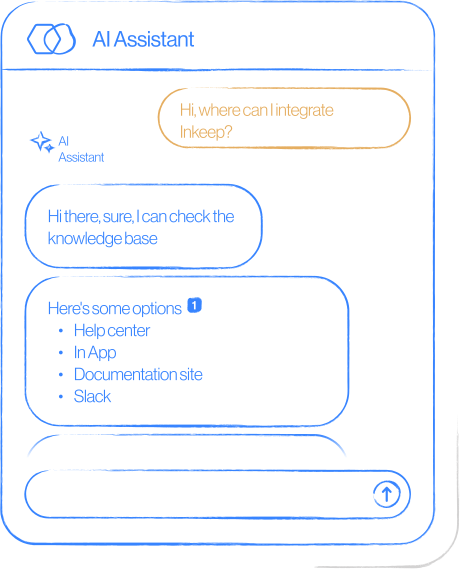
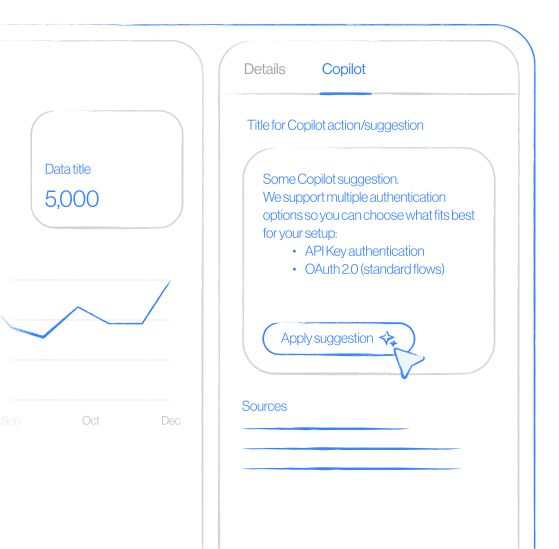
Inline Citations: Every summary statement links to its source message or documentation snippet. SMEs verify claims in one click instead of scrolling through 47-message threads (evidence: INK-004)
-
Confidence-Based Guardrails: When confidence drops—ambiguous technical issues, new product areas—Inkeep flags the summary for human review and can auto-escalate based on your thresholds (evidence: INK-011)
The result: structured context that regenerates on every ticket update, not just when someone remembers to click "summarize."
For deeper context on how AI agents handle escalation workflows, the architecture matters as much as the features.
Recommendations
Your starting point depends on where context loss hurts most.
For Support Directors: Target your highest-escalation queue first. Measure context reconstruction time before and after implementing auto-updating summaries. A 40% ticket escalation rate at $300/ticket creates $288,000 in annual engineering cost. Even a 20% reduction in reconstruction time pays for itself within weeks.
For DevEx Leads: Audit your current CAN report compliance rate. If fewer than 60% of escalated tickets have current, accurate summaries, manual summarization has already failed. The discipline problem isn't fixable with process changes—it requires automation.
If you need immediate ROI proof: Make "tickets bounced back for missing information" your north star metric. This single number captures context loss better than resolution time or escalation volume.
Next Steps
Stop reconstructing context manually. Start seeing what auto-updating summaries actually look like in your workflow.
-
Request a Demo — See auto-updating summaries regenerate live as new messages arrive in Zendesk
-
Use an Enterprise Evaluation Rubric — Assess any solution against platform integration, inline citations, and guardrails
Point-in-time summaries create a false sense of documentation. By the third reply, your CAN report is fiction.
Continuous summarization isn't a feature upgrade—it's the difference between context that helps and context that misleads.
Frequently Asked Questions
Every new message invalidates them. Agents skip updates under pressure.
They regenerate on every ticket change without manual triggers.
Test for platform integration, inline citations, and confidence guardrails.