


AI Chat for Product Roadmaps: Extract Insights from Support Data


Learn how AI chat with citations and semantic search transforms support tickets into prioritized feature requests for your product roadmap.
Support tickets contain roadmap intelligence—most teams never extract it.
Decision
How can AI chat extract feature requests from support data to inform product roadmaps?
AI chat with citations and semantic search transforms support tickets into prioritized feature requests. Three capabilities are required: grounded responses (not hallucinated), traceable citations (for PM verification), and semantic clustering (to surface patterns across time).
Support tickets cost $100 each to resolve. But the real loss isn't resolution cost—it's product intelligence that never reaches your roadmap.
Most AI tools measure tickets resolved, not insights extracted. Feature requests stay buried. Manual ticket review doesn't scale. Generic AI produces unverifiable noise.
The solution sits between: AI grounded in your actual data, with every claim linked to source tickets PMs can verify.
Decision Framework
Not all AI tools extract product intelligence. 40% of AI customer service implementations fail—most because they generate plausible-sounding answers without verification.
Technical audiences dismiss ungrounded responses immediately. Enterprise product teams consistently report that generic AI assistants lack the citations needed to trust outputs for roadmap decisions.
Three capabilities separate usable systems from expensive noise:
| Criterion | What to Look For | Why It Matters |
|---|---|---|
| Product Expert Chat | Indexes internal docs, external knowledge bases, and support history; fully configurable to your domain terminology | Generic models miss product-specific context. Your AI needs to understand your product as deeply as your best support engineer. |
| Enterprise Search | Semantic understanding across time, not keyword matching; clusters related tickets regardless of phrasing | Customers describe the same problem dozens of different ways. Semantic search surfaces patterns keyword search misses. |
| Inline Citations | Every insight links to source ticket or document; clickable references for verification | PMs won't add uncited suggestions to roadmaps. Citations transform AI output from "interesting" to "actionable." |
The citation requirement is non-negotiable. Product managers need to verify context before prioritizing features. Unlinked AI summaries create extra work—someone still has to find the original tickets.
Implementation Path
Most teams lack a systematic process to convert support ticket patterns into prioritized feature requests. Here's the three-phase approach.
Phase 1: Index Your Support Channels
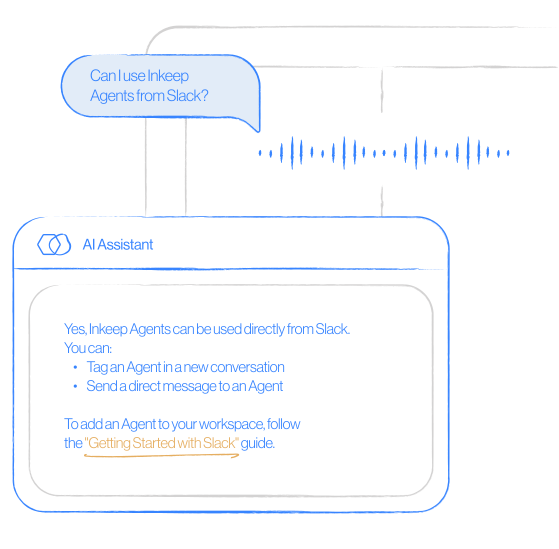
Connect Zendesk, Slack, and documentation into a semantic search layer. This foundation enables pattern recognition across historically siloed data.
Start with one channel. Validate citation accuracy before expanding. Teams that rush multi-channel deployments spend months fixing data quality issues.
Phase 2: Deploy Chat That Clusters and Quantifies
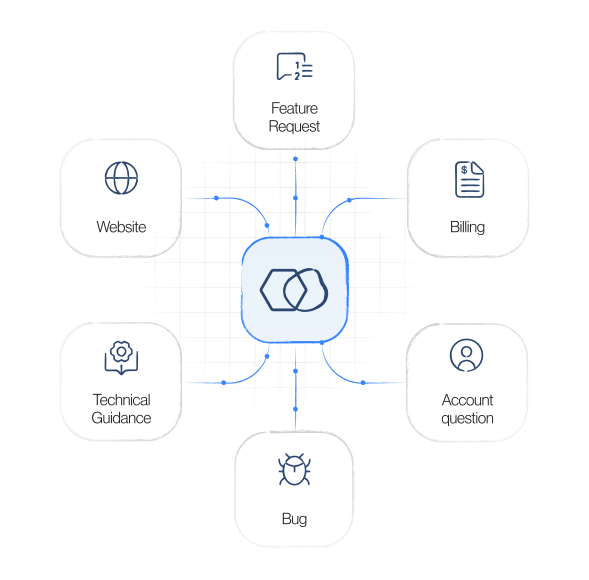
Generic search returns individual tickets. Semantic clustering surfaces patterns: "47 users requested this feature" beats "here's one relevant conversation."
The AI should surface frequency alongside business context. A feature request from a churning enterprise account carries different weight than the same request from a trial user.
Phase 3: Automate Gap Analysis Reporting
Route weekly reports to product teams—automated, cited, prioritized by impact.
One analysis of enterprise implementations examined tens of thousands of support tickets. That volume makes manual review impossible. But without citations, automated insights become unverifiable noise.
Each report should answer: What questions do users ask that documentation doesn't answer? What features do multiple accounts request? Which gaps correlate with churn signals?
| Phase | Duration | Success Metric |
|---|---|---|
| Index one channel | 2 weeks | 90%+ citation accuracy |
| Add clustering | 4 weeks | PMs use reports weekly |
| Full automation | Ongoing | Gap reports influence roadmap |
How Inkeep Helps
Inkeep delivers the three capabilities this framework requires—without the implementation failures that plague 40% of AI customer service projects.
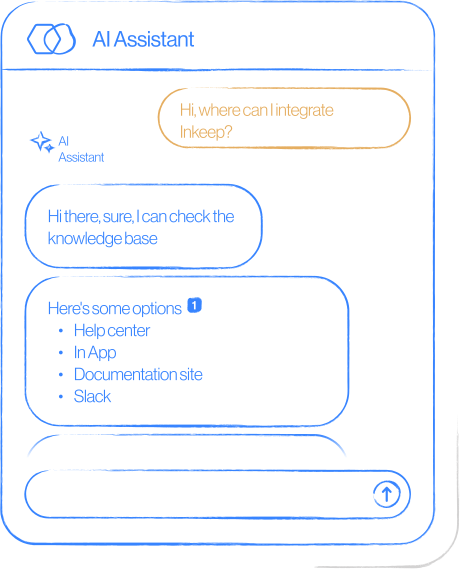
- Product Expert Chat grounded entirely on your indexed content: docs, support channels, and internal knowledge bases
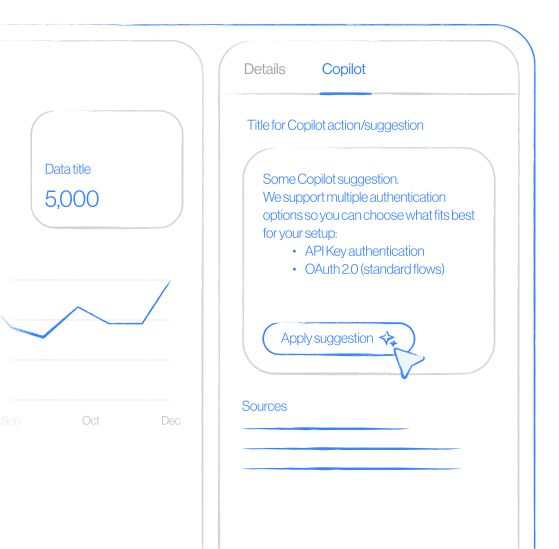
- Inline citations with clickable source links in every response, so PMs can verify before adding anything to the roadmap
- Semantic search that surfaces related tickets across time periods—replacing keyword-matching tools that miss contextual connections
Gap analysis reports automatically identify where documentation falls short based on real user questions. These reports translate directly into roadmap priorities.
One technical company achieved a 33% auto-resolution rate using this approach. Their Lead Designer noted: "Inkeep has come along with the right tools on top of the right models that bring everything together."
Recommendations
Your implementation path depends on your current role and workflow.
For DevEx Leads: Start with gap analysis on existing support data before building anything. Identify your top 5 feature request clusters first. This baseline reveals which patterns warrant engineering investment versus documentation fixes.
For Support Directors: Prioritize citation accuracy over deflection rate. Unverified AI answers erode customer trust faster than slow human responses. When evaluating tools, test citation reliability on your most technical queries—that's where generic AI fails.
For Product Managers: Request weekly reports on "questions without good answers." These map directly to documentation gaps and feature opportunities. Companies improving retention by just 5% see significant profit increases. Feature requests buried in support conversations are early churn signals.
Trade-off to acknowledge: Real-time extraction has latency limitations. Enterprise ops leaders report that new conversations can take up to 20 minutes to surface in analytics dashboards. Batch reporting—daily or weekly aggregations—delivers more reliable input for roadmap decisions than real-time feeds.
The pattern: start narrow (one support channel), validate citation accuracy manually, then expand coverage once you trust the outputs.
Next Steps
Your support data already contains the roadmap insights you need. The question is whether you're extracting them.
- Request a Demo — Bring your actual support data. In 30 minutes, see which feature requests cluster together and where your docs fall short.
- Download the Evaluation Rubric — Assess any AI support platform against citation accuracy, semantic clustering, and source traceability.
Start small. Index a single support channel. Validate citation accuracy on 50 tickets. If the sources check out, expand. If they don't, you've lost a week—not a quarter.
Frequently Asked Questions
They generate plausible answers without citations PMs can verify.
It clusters related tickets regardless of how customers phrase problems.
Batch reporting (daily/weekly) delivers more reliable roadmap input.
Index one channel, test citation accuracy on 50 tickets.