


Agentic AI Support: From Answers to Actions in 2026


Learn to implement agentic AI support with MCP actions, multi-agent coordination, and credential management. Phase-by-phase guide for 2026.
75% of AI implementations fail because they answer questions but can't take actions.
Decision
How do we move from AI that answers questions to AI that resolves problems by taking action across our support stack?
Agentic workflows require three capabilities: MCP server actions, multi-agent coordination, and credential management. Without all three, AI stays a faster search box.
Only 25% of organizations achieve measurable business impact from AI implementations. The other 75% built chatbots that answer questions but can't reset passwords, update tickets, or provision accounts.
In conversations with enterprise ops leaders, one pattern emerges repeatedly: questions asked 20 times per day still require manual responses. Their AI knows the answer. It just can't act on it.
Action-taking transforms support from retrieval to resolution. That requires tooling most platforms don't provide.
Decision Framework
Three capabilities separate action-taking AI from sophisticated search boxes. Evaluate platforms against these criteria before committing.
| Criterion | What to Look For | Why It Matters |
|---|---|---|
| MCP Server Actions | Model Context Protocol support for ticketing, billing, and user management integrations | Standardized tool connections let agents update tickets, add users, and modify accounts—not just describe how to |
| Multi-agent Coordination | Both delegation (supervisor stays involved) and handoff (full transfer) patterns | Escalation workflows need flexibility; some issues require oversight while others benefit from clean transfers |
| Agent Credentials/Permissions | Per-agent API keys and isolated access levels | Different agents need different permissions; credential isolation contains blast radius when things go wrong |
The credentials gap is particularly acute. 58-59% of organizations report AI monitoring capabilities, but only 37-40% have true containment controls. Monitoring tells you what happened, but containment prevents damage.
As NIST CAISI notes: "AI agent systems are capable of planning and taking autonomous actions that impact real-world systems. While these systems promise significant benefits, they present unique security challenges."
Without all three capabilities, your AI remains advisory rather than operational.
Implementation Path
To be clear, Agentic support doesn't require a big-bang deployment. So a phased approach builds trust, proves value, and limits blast radius when things go wrong.
Phase 1: Connect (Weeks 1-4)
Start with your knowledge base plus one action system—typically ticketing or user management. The goal isn't automation volume. It's proving the AI can take a single action reliably.
Measure: Can the AI retrieve context and create/update a ticket without human intervention? One support platform achieved a 40% increase in automated ticket resolution after connecting Claude to their ticketing system via Amazon Bedrock.
Don't skip this phase. Teams frequently report being blocked from implementing automation use cases they've already defined. Building this foundation is necessary.
Phase 2: Coordinate (Weeks 5-12)
Add multi-agent patterns for escalation. Start with delegation—the supervisor agent stays involved and can intervene. Only move to full handoffs after delegation patterns prove stable.
This phase introduces complexity. One agent retrieves billing data. Another updates user permissions. A coordinator routes between them. Without explicit coordination patterns, agents step on each other or drop context mid-resolution.
Measure: Escalation accuracy and resolution time for multi-step requests.
Phase 3: Expand (Months 3-6)
Add credential isolation and additional MCP servers as trust is established. Different agents need different API keys. A knowledge agent shouldn't have billing write access.
We've seen enterprises document a 90% reduction in administrative effort after expanding Agentic-workflows across their ticket processing workflow.
Measure: Resolution coverage (percentage of ticket types handled end-to-end) and security audit results.
The gate between phases matters more than the phases themselves. Each phase needs measurable outcomes before proceeding. Rushing to Phase 3 with Phase 1 problems creates expensive rework.
How Inkeep Helps
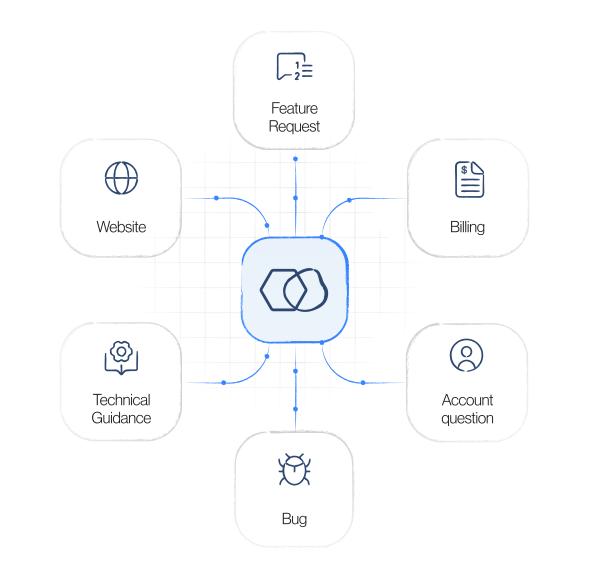
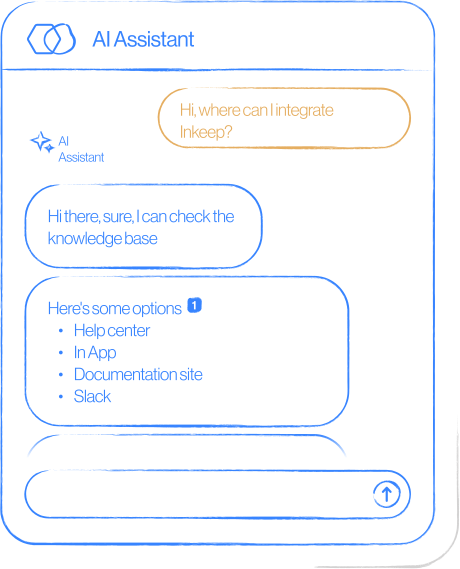
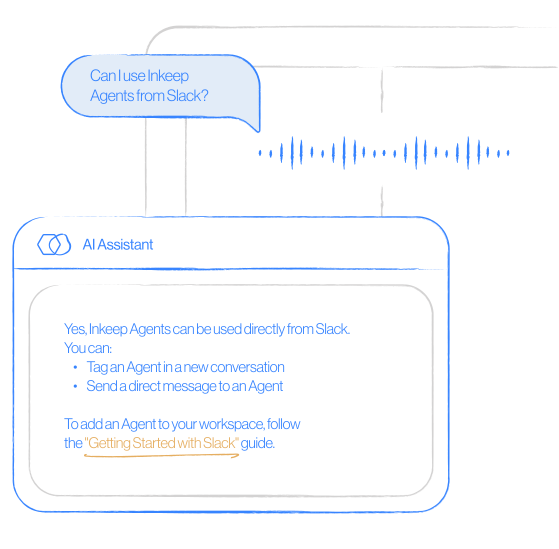
Inkeep delivers the three capabilities this framework requires. MCP server support connects actions across Zendesk, user management systems, and knowledge bases—so your AI agent resolves problems instead of describing solutions.
Citation-first RAG grounds every response in your documentation, addressing the hallucination risk that erodes customer trust. Teams report 20+ clear hallucinations from generic AI tools. Citations eliminate that failure mode.
The platform bridges technical and operational teams. Business users configure workflows visually while developers extend with TypeScript, so changes sync between both interfaces.
Inkeep already powers agentic support for companies like Anthropic, Datadog, and PostHog. Typical deployments achieve 25-50% ticket deflection, but deflection alone undersells the value. The real metric is resolution without escalation—problems solved, not just questions answered.
Recommendations
Your implementation path depends on your role and risk tolerance.
For DevEx leads: Begin with developer documentation connected to API integrations. Measure time-to-first-successful-API-call—not just deflection. Gap analysis reports reveal exactly where docs fall short based on real customer questions, letting you fix root causes instead of answering the same thing forever.
For Support Directors: Prioritize ticket deflection, but track resolution quality alongside volume. AI-powered features drive a 30% increase in support agent productivity. The trap is celebrating deflection numbers while customer satisfaction drops. Measure both.
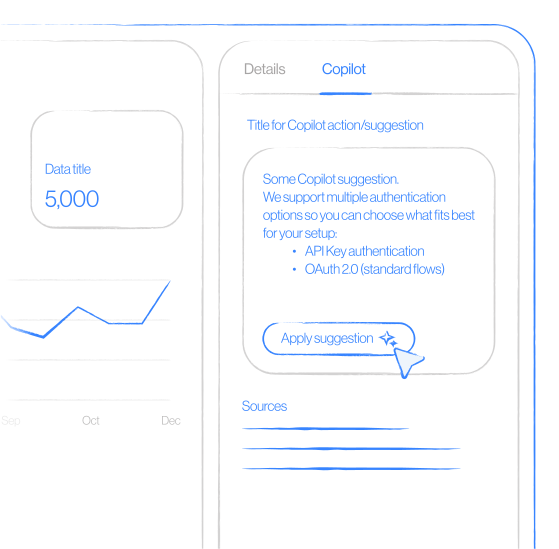
If you need quick wins: Start with co-pilot mode. Agents verify AI suggestions before actions execute. You get productivity gains without autonomous risk. Build trust before expanding scope. We offer this at Inkeep.
If you need control: Implement credential isolation before adding action systems. Different agents need different API keys. One compromised workflow shouldn't access your entire stack.
| Starting Point | First Action | Success Metric |
|---|---|---|
| DevEx | Doc + API integration | Time-to-first-API-call |
| Support | Co-pilot mode | Deflection + CSAT |
| Security-first | Credential isolation | Blast radius containment |
Next Steps
86% of companies expect to be operational with AI agents by 2027. The question isn't whether to adopt agentic support—it's how quickly you can close the gap between answering and resolving.
Two paths forward based on where you are today:
Ready to evaluate: Request a demo to see MCP actions and multi-agent coordination in your actual environment. We'll connect to your ticketing system and show delegation patterns working against real workflows.
Still building the business case: Download our evaluation rubric to assess any platform against the three criteria: MCP server actions, multi-agent coordination, and credential isolation.
| Capability | What You'll See |
|---|---|
| MCP actions | Ticket updates, user provisioning, and knowledge base queries executed in your systems |
| Multi-agent coordination | Delegation and handoff patterns for escalation workflows |
| Credential isolation | How different agents operate with scoped permissions |
The 75% failure rate isn't inevitable. Organizations that achieve measurable impact start with clear criteria and validate against real workflows before committing.
-
Request a Demo — See agentic support in your environment
-
Download the Evaluation Rubric — Use our framework to assess any platform
About the author

Frequently Asked Questions
Agentic AI executes actions like updating tickets, not just answering questions.
Phased approach: 4 weeks to connect, 12 weeks to coordinate, 6 months to expand.
Missing credential isolation—one compromised workflow shouldn't access everything.
Connect your knowledge base to one action system, typically ticketing.